
Hair Mesotherapy in Ahmedabad, Gujarat
Written and medically reviewed by Dr Arth Shah, MBBS (Gujarat University, 2009), MS General Surgery (Sardar Patel University, 2014), MCh Plastic & Reconstructive Surgery (B.J. Medical College, Ahmedabad, 2017). Gujarat Medical Council registration G-25994. Practising in Ahmedabad since 2018.

Mesotherapy means injecting small amounts of something into the skin. For hair, that means a series of tiny injections into the scalp at the level of the follicles. The important thing – and the thing almost no clinic tells you – is that “mesotherapy” describes the method, not the medicine. What is actually in the syringe varies enormously between clinics, and it is the only thing that determines whether the treatment does anything. Some formulations have reasonable evidence behind them. Most of what is sold does not.
If you have been quoted for hair mesotherapy somewhere, here is a question worth asking before you pay: what is in it? Most people are surprised that this is a real question. Mesotherapy sounds like a specific treatment, in the way that a hair transplant is a specific treatment. It is not. It describes a delivery method – injecting a small quantity of something into the middle layer of the skin, close to the hair follicles, rather than swallowing it or rubbing it on. What gets injected is entirely up to the clinic, there is no standard formulation, and the range runs from prescription medicines with published trials behind them to vitamin cocktails with essentially nothing.
So a page that simply says “mesotherapy works” is not telling you anything useful, and neither is one that says it does not. The honest answer depends on the contents of the syringe, and this page is written to help you ask about that – here or anywhere else. It covers what the published research actually shows, including a study that found no significant benefit, where mesotherapy sits relative to minoxidil, finasteride and PRP, what it costs, and who it is and is not worth trying for.
What mesotherapy actually is
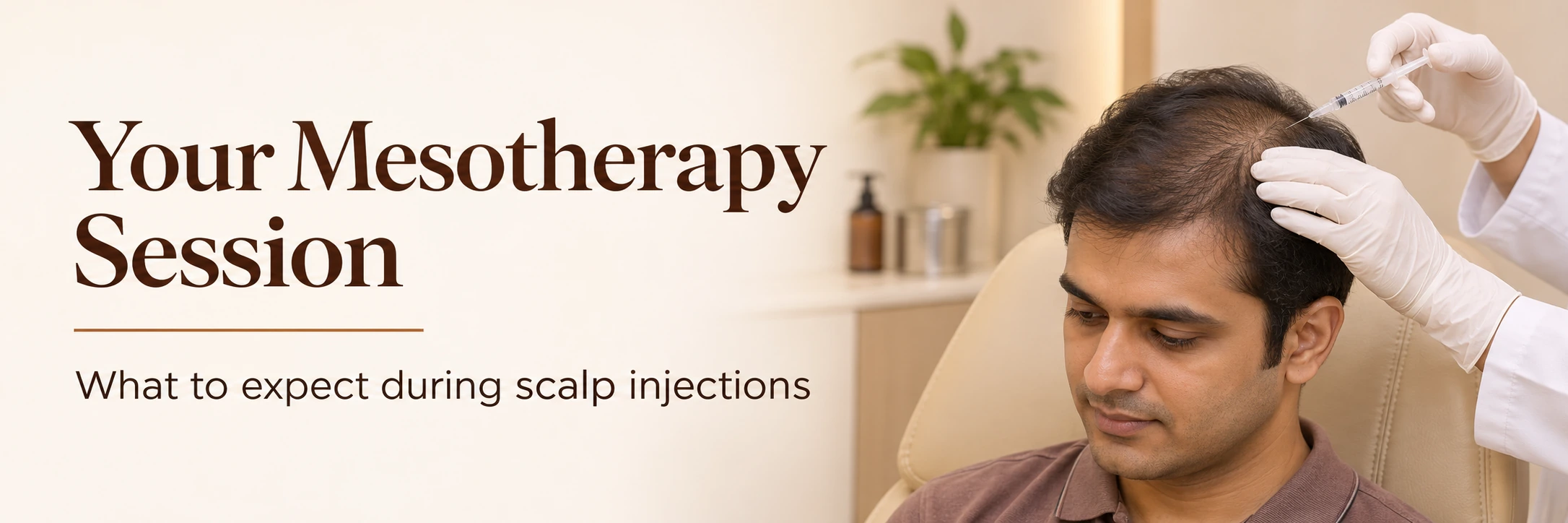
A series of small injections placed into the dermis – the middle layer of skin – across the thinning area of the scalp. Each injection delivers a fraction of a millilitre. The idea is to put an active agent directly where the follicles are, rather than relying on a topical solution to penetrate or a tablet to reach the scalp through the bloodstream. A session covers the treatment area with dozens of these micro-injections and takes fifteen to twenty minutes.
It is a delivery method, not a treatment
This is the thing to understand and it changes how you should read every other mesotherapy page you encounter.
“Mesotherapy” is like the word “tablet”. It tells you the form, not the medicine. Two clinics can both offer hair mesotherapy at similar prices and be injecting completely different things – one a prescription anti-androgen with published trials behind it, the other a mixture of vitamins and plant extracts with almost none. The word on the price list is identical. Which is why the single most useful thing you can do, at any clinic including this one, is ask for the formulation in writing. A clinic that can tell you exactly what is in the preparation and why has thought about it. A clinic that describes it vaguely as “vitamins and nutrients” is asking you to take it on trust, and there is no reason to.
What is in the injection?
What we use here
Dutasteride blocks the enzyme that converts testosterone to DHT, the hormone that drives pattern hair loss. Taken as a tablet it works well but acts throughout the body; injected into the scalp at low dose, the intention is to act locally. A large real-world study found that serum hormone levels were not meaningfully changed by intradermal dutasteride at low concentration, which is the main argument for using it this way. It is a prescription medicine and this route of use is off-label.
These are intended to support the follicular environment rather than to act on the hormonal cause of pattern hair loss. The published evidence for preparations of this type is considerably weaker than for the medicines listed further down this page, and we would generally recommend it as an addition to those rather than a substitute for them.
What is usually sold as hair mesotherapy
Across the market, the commonest preparations contain some combination of B-complex vitamins including biotin, amino acids, minerals such as zinc, coenzymes, hyaluronic acid, peptides, and plant extracts. Some add dexpanthenol. A smaller number use dutasteride or finasteride. Some add minoxidil.
These are not equivalent. The distinction that matters is whether the preparation contains something that acts on the hormonal driver of pattern hair loss – which is what an anti-androgen does – or whether it contains nutrients intended to support hair generally. The second group is what is most commonly sold and the group with the least evidence behind it.

Does mesotherapy work for hair loss?
It depends on what is in it, and the honest summary is: preparations containing dutasteride have a real but limited evidence base showing improvement in hair density, while the vitamin-based preparations that make up most of the market have very little. Across the field as a whole, a recent systematic review concluded that protocols and outcomes remain heterogeneous – which is a polite way of saying the studies are too varied to give one answer.
What the research shows
A systematic review and meta-analysis of intralesional dutasteride published in 2025 found that the included studies consistently reported improvements in hair density and thickness, with photographic evidence supporting the improvement, and that treatment was generally well tolerated with minimal adverse effects and no significant systemic effects.
That is a genuinely positive finding and it is the strongest thing that can be said for hair mesotherapy. It also comes with an explicit limitation from the authors themselves: the evidence is constrained by heterogeneity and a lack of large-scale, high-quality trials.
A large real-world study of over five hundred patients receiving quarterly low-concentration dutasteride mesotherapy reported benefit in both men and women, and found no meaningful change in serum hormone levels – which matters, because avoiding the systemic effects of an oral anti-androgen is the entire rationale for giving it this way.
Where the evidence is weak
And here is the counterweight, which no clinic page in this market publishes. A case series from NYU following ten patients on dutasteride mesotherapy found no statistically significant change in hair density or diameter. Two patients improved, four did not respond at all, and four had variable results. The authors described the response as highly inconsistent.
A separate review noting the limitations of the existing dutasteride trials makes a point that is easy to miss: only a few small randomised trials have tested intradermal dutasteride, and all of them used preparations that also contained other hair-growth-promoting ingredients. So even the positive trials cannot cleanly attribute the benefit to the dutasteride.
Three fair conclusions from that. Response is variable and some people get nothing. The studies are small. And the field has not settled on a standard protocol, which is why two clinics doing “the same” treatment may not be doing the same treatment at all.
Where mesotherapy sits against the alternatives
Below minoxidil and finasteride, and below PRP. That is the honest ranking on current evidence, and a clinic that also offers all of those has no reason to tell you otherwise.
Treatment | Evidence base | Where it sits |
Minoxidil (topical) | Strong. Large trials, approved for this indication. | First line. Cheapest, best evidenced. |
Finasteride (oral, men) | Strong. Large trials, approved for this indication. | First line for men. Not routinely used in women of childbearing potential. |
PRP – see PRP for hair loss | Moderate. Multiple randomised trials and meta-analyses, though protocols vary. | A reasonable adjunct. |
Dutasteride mesotherapy | Limited but real. Small trials, one meta-analysis, at least one negative series. | A reasonable option where systemic anti-androgens are unsuitable or unwanted. |
Vitamin or peptide mesotherapy | Weak. Little controlled evidence. | An adjunct at best. Not a substitute for the above. |
Homeopathic preparations | None. | Not something we would recommend injecting. |
None of this means mesotherapy is worthless. It means it should be an addition to treatments that work rather than a replacement for them, and it should be priced and described accordingly.
Who it suits, and who it does not
Mesotherapy is worth considering if you have early to moderate pattern hair loss, you are already on medical treatment and want to add to it, or you cannot tolerate or do not want oral medication. It is not worth starting if you have not had your bloods checked, if you have a completely bald area, or if you are using it instead of the better-evidenced options.
Reasonable candidates
- Early to moderate thinning with hair still visible in the area. Like PRP, it acts on follicles that are still there. It cannot do anything where they have gone.
- Already on minoxidil, wanting to add something. This is the honest use case.
- Unable or unwilling to take oral finasteride or dutasteride. If the preparation used is anti-androgen-based, this is the strongest argument for it – local delivery without the systemic exposure.
- Women, for whom oral anti-androgens are more restricted – see female pattern hair loss.
Not suitable
- Anyone who has not had blood tests. Iron deficiency, thyroid disease and PCOS all cause hair thinning and all are treatable. Injecting a scalp while an untreated deficiency drives the loss is money badly spent.
- A completely bald area. No follicles, nothing to act on.
- Anyone using it instead of medication rather than alongside it.
- Women who are pregnant, breastfeeding or could become pregnant, if the preparation contains dutasteride or finasteride. This is not a soft caution – these drugs carry risk to a developing male foetus and the intradermal route does not remove that concern.
- Active scalp infection or inflammatory scalp disease.
Bleeding disorders or anticoagulant therapy, as with any injectable.
The session, step by step
A session takes about thirty minutes in total, of which the injections themselves are fifteen to twenty. Numbing cream is applied first. You walk out immediately afterwards and can go back to work the same day.
Step 1 – Assessment
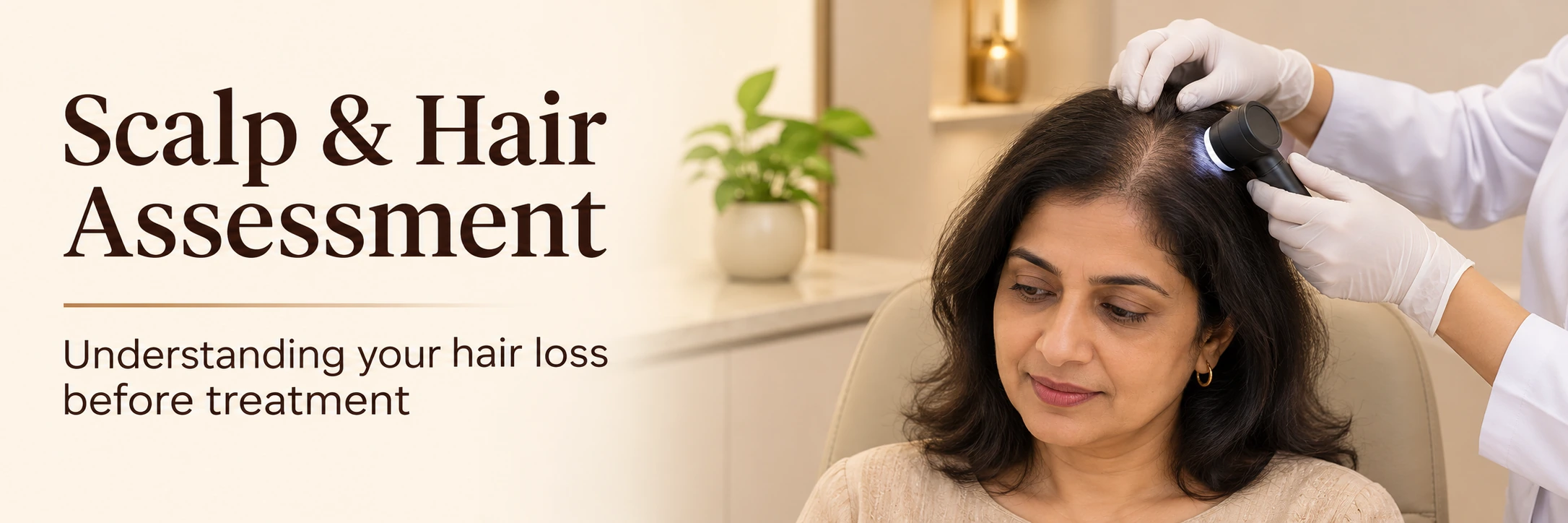
Examination of the scalp, staging of the hair loss, and – as on every hair page on this site – confirmation that a treatable cause has been excluded first. Photographs from standard angles, because the change from mesotherapy is gradual and cannot be assessed from memory.
Step 2 – Blood work, first time
Ferritin, full blood count, thyroid function and vitamin D at minimum, with hormonal tests where indicated. This is the step that should happen before any injectable treatment is started, and it is the one most commonly skipped.
Step 3 – Numbing
Topical anaesthetic cream applied to the treatment area and left for twenty to thirty minutes. Most of the visit is this waiting period.
Step 4 – Injection
The preparation is injected into the dermis across the thinning area using a fine needle, with injection points roughly a centimetre apart. Each injection delivers a very small volume. It feels like a series of quick pinpricks and pressure rather than pain.
Step 5 – Afterwards
No dressing. The scalp may look slightly red or show small raised points for a few hours. You leave and carry on with your day. Aftercare instructions and the next appointment date.
How many sessions, and then what
Protocols vary widely, which is itself part of the problem – there is no agreed standard. Vitamin-based preparations are typically given weekly to fortnightly for several sessions, then monthly. Dutasteride-based preparations have been studied at much longer intervals, in some cases quarterly. Whatever the schedule, this is ongoing treatment rather than a course you complete. That last point matters as much here as it does for PRP. Pattern hair loss is progressive, and a treatment that acts on the follicular environment or on local hormone levels only works while it is being given. Stop, and the underlying process resumes.

Downtime and aftercare
Essentially none. The scalp is slightly tender and may look pink with small raised points for a few hours, settling by the next morning. Avoid washing your hair, strenuous exercise, swimming, sauna and direct sun for the rest of the day, and leave chemical hair treatments for about forty-eight hours.
When | What to expect | What to do |
Same day | Mild tenderness, slight redness, occasionally small raised bumps at injection points. | Back to work. No hair wash, no gym, no swimming. |
Next day | Back to normal appearance. | Wash hair normally with a mild shampoo. |
Day 2-3 | Nothing. | Normal activity. Avoid chemical treatments until day three. |
Between sessions | No visible change for the first two to three months. | Continue any medication you are on. Do not stop minoxidil because you have started this. |
Call the clinic if
- Redness, swelling or pain increases after the first day rather than settling.
- There is discharge from an injection site, or fever.
- An itchy raised rash develops in the treated area.
- You notice hair loss increasing in the treated area. Uncommon, but paradoxical hair loss after mesotherapy has been reported in the literature and it should be reviewed rather than persisted with.
Hair mesotherapy cost in Ahmedabad, Gujarat
Sessions are typically priced between Rs 2,500 and Rs 6,000 depending on the preparation used and the area treated, which makes an initial course of four to six sessions roughly Rs 12,000 to Rs 30,000. The figure that matters more is the annual cost including maintenance, because this is ongoing treatment rather than a course you finish.
What | Typical cost in Ahmedabad |
Single session | Rs 2,500 – 6,000 |
Initial course of 4-6 sessions | Rs 12,000 – 30,000 |
Maintenance session | Contact our clinic |
Consultation | Contact our clinic |
Blood panel, first visit | Rs 800 – 2,500 |
If the preparation contains a prescription medicine | May be priced differently |
What a full course actually costs
Year | What happens | Indicative total |
Year 1 | Initial course plus maintenance | Contact our clinic |
Year 2 onwards | Maintenance only | Contact our clinic |
If you stop | The underlying loss resumes | Nil, and back where you were heading |
Why quotes vary
Three things, and the first dwarfs the other two.
- What is in the preparation. A prescription anti-androgen compounded for intradermal use costs a clinic considerably more than a vitamin ampoule. If two quotes differ by a factor of two, that is usually why – and it is why you should ask what is in it before comparing prices at all.
- Who performs it – a doctor or a technician.
- Whether it is sold as a session or bundled into a package with PRP, medication and follow-up, which makes direct comparison difficult and is often the point.
Results timeline
Nothing visible for the first two to three months. Where mesotherapy works, reduced shedding is usually the first thing noticed, followed by gradual thickening of existing hair from around month three or four. Assess at six months with standardised photographs, and be prepared for the honest possibility that there is no clear change – the published response rates are variable and some people get nothing.
When | What is happening |
Weeks 1-8 | Nothing visible. Sessions continue. |
Month 2-3 | Reduced shedding in some patients – usually the first sign if there is going to be one. |
Month 3-4 | Gradual thickening of existing hair, where response occurs. |
Month 6 | The assessment point. Compare standardised photographs, not impressions. |
Beyond 6 months | Maintenance holds whatever was gained. Stopping returns you to the underlying trajectory. |
Comparing your options
Mesotherapy vs PRP
Both are injectable, both are given as a course with maintenance, and both act on follicles that are still present. The difference is what is injected and how much evidence sits behind it. PRP uses your own blood concentrated for platelets and has multiple randomised trials and meta-analyses behind it. Mesotherapy uses an external preparation whose evidence depends entirely on what that preparation contains.
| Mesotherapy | PRP |
What is injected | An external preparation – varies by clinic | Your own platelet-rich plasma |
Evidence base | Limited and formulation-dependent | Moderate – multiple RCTs and meta-analyses |
Standardisation | None. Protocols and formulations vary widely | Also variable, but the material itself is consistent |
Allergy risk | Possible – it is a foreign substance | Effectively none – it came from you |
Session length | ~30 minutes | ~45-60 minutes |
Typical cost per session | Rs 2,500 – 6,000 | Rs 5,000 – 12,000 |
Ongoing | Yes, indefinitely | Yes, indefinitely |
If you are choosing between them on evidence alone, PRP is the better-supported option – see PRP for hair loss, which sets out what that evidence does and does not show. Where mesotherapy has a specific argument is if the preparation contains an anti-androgen, because that acts on the cause of pattern hair loss rather than the environment around it, and PRP does not.
Mesotherapy vs minoxidil and finasteride
There is no real contest on evidence. Minoxidil and finasteride are approved for pattern hair loss, have large trials behind them, and cost a fraction as much per year. If you are not on either and you are considering mesotherapy instead, that is the conversation to have first.
The legitimate case for mesotherapy against them is narrower and worth stating precisely: it applies if you cannot tolerate or do not want an oral anti-androgen, if you are a woman for whom finasteride is not appropriate, or if you are already on medication and want to add something. Used as an addition it is defensible. Used as a replacement it is not.
Mesotherapy vs a hair transplant
They do different jobs and are not really alternatives. Mesotherapy acts on existing follicles that are miniaturising; it cannot create hair where the follicles have gone. A transplant moves follicles into a bald area and is the only thing that does. The two combine perfectly well – and after a transplant, keeping the surrounding native hair is exactly the job medical treatment is for.
See FUE hair transplant. If your thinning area is genuinely bald rather than thinning, that page is the honest place to start, and no injectable will change that.
Risks and side effects
Mesotherapy is low-risk as a procedure. The realistic side effects are scalp tenderness for a few hours, redness, small bumps at injection points, occasional bruising, and rarely infection. What differs from PRP is that a foreign substance is being injected, so allergic reaction is possible – and where the preparation contains a prescription medicine, that medicine’s own considerations apply.
What to expect
- Tenderness and mild redness for a few hours to a day.
- Small raised points at injection sites, settling overnight.
- Occasional bruising, particularly at the temples.
- Mild headache on the day in some patients.
Less common, and worth knowing
- Allergic reaction to the preparation. Uncommon but possible, and it is the reason knowing the ingredients matters.
- Infection at an injection site.
- Paradoxical hair loss. Reports exist in the literature of increased hair loss following dutasteride mesotherapy in a small number of patients. It is rare, but it is documented, and it is not mentioned on any clinic page in this market. If shedding increases in the treated area, that should be reviewed rather than persisted with.
- Where the preparation contains dutasteride or finasteride: the pregnancy considerations for those drugs apply. They should not be used in women who could become pregnant. Intradermal delivery reduces systemic exposure but does not eliminate the concern, and any clinic offering this to women of childbearing age should be discussing it explicitly.
Not offered if
- There is active infection or inflammatory skin disease on the scalp.
- You have a bleeding disorder or are on anticoagulants.
- You are pregnant or breastfeeding – and particularly if the preparation contains an anti-androgen.
- You have a known allergy to any component of the preparation.
- The target area is completely bald, in which case it will not work rather than being unsafe.
How to choose where to have hair mesotherapy
One question separates providers more reliably than any other: what is in the preparation, and can I have that in writing? A clinic that answers precisely has thought about what it is injecting. A clinic that says “vitamins and nutrients” and moves on is asking you to buy something it will not describe.
Six questions worth asking anywhere, including here
- What exactly is in the preparation, and at what concentration? Ask for it in writing. This is the whole ballgame.
- Does it contain a prescription medicine? If yes, that should be disclosed along with the fact that this route is off-label, and the safety implications explained.
- What blood tests should I have first? If the answer is none, that tells you what kind of clinic it is.
- Should I be on minoxidil as well? If a clinic selling injections does not raise the cheaper, better-evidenced option, ask why.
- Will standardised photographs be taken at baseline and six months? Without them nobody can tell whether it worked.
- What is the total cost for a year including maintenance? Not the per-session price.
Your doctor: Dr Arth Shah, MS, MCh (Plastic Surgery)
Hair mesotherapy at Rejuva Aesthetica is performed by Dr Arth Shah, who completed his MBBS at Gujarat University in 2009, his MS in General Surgery at Sardar Patel University, Vallabh Vidyanagar in 2014, and his MCh in Plastic and Reconstructive Surgery at B.J. Medical College, Ahmedabad in 2017 – the full superspecialty surgical training pathway in India. He is registered with the Gujarat Medical Council under registration number G-25994 and has practised in Ahmedabad since 2018, the year he founded Rejuva Aesthetica.
Book a consultation in Ahmedabad
A consultation takes about 20 minutes. Your scalp is examined and staged, and you are told whether mesotherapy is likely to help you – and where it sits against the alternatives. If the honest answer is that you should start on topical treatment and have your bloods checked first, that is what you will hear.
Rejuva Aesthetica – Plastic & Cosmetic Surgery Clinic 102, Himalaya Emerald, Besides IOC Petrol Pump, Near Shivranjani Over Bridge, Jodhpur, Ahmedabad, Gujarat 380015 Phone: +91 74360 00990 | 079 2692 9299 Monday to Saturday, 9:00 AM to 7:00 PM. Closed Sundays and public holidays. |
Frequently Asked Question
It depends entirely on what is in the injection, which is the thing most clinics do not tell you. Preparations containing dutasteride have a real but limited evidence base showing improvement in hair density. The vitamin and peptide cocktails that make up most of the market have very little behind them. A 2026 systematic review of injectable therapy for hair loss concluded that protocols and outcomes remain heterogeneous - the studies are too varied to give one answer.
It varies enormously and there is no standard formulation. Common ingredients include B-complex vitamins, biotin, amino acids, minerals, peptides, hyaluronic acid and plant extracts. A smaller number of preparations contain dutasteride, finasteride or minoxidil. Those are not equivalent - the ones containing an anti-androgen act on the hormonal cause of pattern hair loss, the rest do not. Always ask for the formulation in writing.
A technique. "Mesotherapy" describes injecting small amounts of something into the middle layer of the skin. It tells you nothing about what is being injected, which is the only thing that determines whether it works. Two clinics can both offer hair mesotherapy at similar prices and be injecting completely different things.
Sessions typically run Rs 2,500 to Rs 6,000 depending on the preparation, so an initial course of four to six sessions is roughly Rs 12,000 to Rs 30,000. Because it is ongoing treatment rather than a course you finish, the more useful figure is the cost for a full year including maintenance.
On current evidence, no. PRP has multiple randomised trials and meta-analyses behind it; mesotherapy evidence is thinner and depends on the formulation. PRP also uses your own blood, so there is no allergy risk. Mesotherapy has a specific argument only where the preparation contains an anti-androgen, because that acts on the cause of pattern hair loss rather than the environment around it.
No. Minoxidil is approved for pattern hair loss, has large trials behind it, and costs a fraction as much per year. If you are not using it and are considering mesotherapy instead, that is the conversation to have first. Mesotherapy is defensible as an addition to medication, not as a replacement for it.
Protocols vary widely, which is part of the problem - there is no agreed standard. Vitamin-based preparations are typically given weekly to fortnightly for several sessions then monthly. Dutasteride-based preparations have been studied at much longer intervals, in some cases quarterly. In every case it is ongoing treatment rather than a course you complete.
Numbing cream is applied for twenty to thirty minutes beforehand and the injections feel like a series of quick pinpricks and pressure over fifteen to twenty minutes. Most people find it very manageable. The scalp is tender for a few hours afterwards.
Usually just tenderness, redness and small bumps at injection points for a few hours. Because a foreign substance is being injected, allergic reaction is possible - unlike PRP, which uses your own blood. Paradoxical hair loss has been reported in a small number of patients after dutasteride mesotherapy, which is rare but documented.
Yes, and it can be useful because oral anti-androgens are more restricted in women. But if the preparation contains dutasteride or finasteride, it should not be used in women who could become pregnant - those drugs carry risk to a developing male foetus and intradermal delivery does not remove that concern. Ask specifically what is in it.
No. Like PRP, mesotherapy acts on follicles that are still present but shrinking. Where the scalp is smooth and there is nothing growing, the follicles have gone and there is nothing to act on. That situation needs a transplant or scalp micropigmentation.
Nothing visible for the first two to three months. Reduced shedding is usually the first sign where there is going to be one, followed by gradual thickening from around month three or four. Assess at six months with standardised photographs - and be prepared for the possibility of no clear change, because response is variable.
No. Like every non-surgical hair treatment, it works while it is being given. Pattern hair loss is progressive, so stopping returns you to the underlying trajectory over the following months.
Yes, and this matters more than the choice of injection. Iron deficiency, thyroid disease and PCOS all cause hair thinning and are all treatable. Injecting a scalp while an untreated deficiency drives the loss is money badly spent. Ferritin, full blood count, thyroid function and vitamin D at minimum.
A version where the injected preparation contains low-concentration dutasteride, a drug that blocks conversion of testosterone to DHT - the hormone driving pattern hair loss. Taken orally it works well but acts throughout the body; injected into the scalp the intention is to act locally. It has the most evidence of any mesotherapy variant, though that evidence is still limited, and it is a prescription medicine used off-label by this route.
Yes. They do different jobs - a transplant puts follicles where there are none, and medical or injectable treatment protects the native hair around them. If anything, keeping the surrounding hair is exactly what a transplant patient needs, though medication does that job with better evidence and lower cost.
Mostly because of what is in the preparation. A prescription anti-androgen compounded for intradermal use costs the clinic considerably more than a vitamin ampoule. Who performs it and whether it is bundled into a package account for the rest. Ask what is in it before comparing prices at all.
As a procedure, yes - it is low-risk. The safety questions attach to what is being injected rather than to the injecting. That is another reason to know the formulation, and it is why a preparation containing a prescription medicine should be disclosed as such.
No, and it should not be offered for it. Dandruff and seborrhoeic dermatitis respond to medicated shampoos and topical antifungals, which are cheap, effective and well evidenced. An injectable treatment is not the answer to a scalp condition that a shampoo treats.
No. PRP injects a concentrate made from your own blood. Mesotherapy injects an externally prepared solution. The technique is similar and both are given as courses with maintenance, but the material and the evidence base are different.
Just another name for hair mesotherapy. Different clinics use different terms - meso hair treatment, mesoscalp, scalp mesotherapy - and none of them tells you what is in the injection, which is the only thing that matters.
Yes, and you generally should. Minoxidil has stronger evidence and lower cost, and there is no conflict between them. A clinic that puts you on injections and does not mention topical treatment is offering you the more expensive half of the answer.
The same caveats apply, with one addition: women should have iron, thyroid and hormonal causes excluded first, because those are commoner in women and all are treatable. If the preparation contains an anti-androgen, the pregnancy considerations are significant.
Mesotherapy requires repeated visits over months, which makes it impractical for most out-of-town patients. If travelling regularly is not realistic, that is a genuine reason to consider whether medication - which needs no appointments - is the better primary treatment.
Start Today
Ready to Get Started?
Book a complimentary consultation to discuss your goals and receive a personalised treatment plan.