Burn Reconstruction in Ahmedabad
Written and medically reviewed by Dr Arth Shah, MBBS (Gujarat University, 2009), MS General Surgery (Sardar Patel University, 2014), MCh Plastic & Reconstructive Surgery (B.J. Medical College, Ahmedabad, 2017). Gujarat Medical Council registration G-25994.
Burn reconstruction is surgery and treatment after a burn has healed, to release tight scars, restore movement and improve appearance. Most burn scars are left to mature for 12 to 18 months while pressure garments, silicone and physiotherapy do their work. Some cannot wait – eyelids that do not close, a mouth that will not open, a neck pulled down, stiff hands, and tight scars in growing children. Treatment includes releasing the scar with skin grafts or flaps, tissue expansion, laser and fat grafting, usually in stages. Government schemes cover functional burn surgery, at package rates of around Rs 50,000-60,000 per joint.
If someone has just been burned
This page is about treatment after a burn has healed. A fresh burn needs emergency care.
Cool the burn under cool running water for 20 minutes. Remove rings, watches and loose clothing near the burn unless they are stuck. Cover loosely with cling film or a clean cloth. Do not use ice, toothpaste, oil or home remedies. Go to the nearest emergency department – urgently for burns to the face, hands, feet, genitals or joints, electrical or chemical burns, and any burn in a child or older person. Call 108.
What burn reconstruction can do
After a burn heals, the scar keeps changing for many months. It can thicken, itch, tighten and pull on nearby skin. Across a joint, that tightness – a contracture – can stop an elbow straightening, a hand opening or the head turning. On the face, it can pull an eyelid or the lip out of place.
- Restore movement in joints, hands and the neck.
- Let eyelids close and the mouth open properly.
- Soften thick, itchy and painful scars.
- Improve the appearance of scars on the face and body.
- Restore hair on scarred scalp, eyebrows or beard.
No treatment makes a burn scar disappear. The aim is comfort, function and a scar that is flatter, softer and less noticeable.
Problems we treat after a burn
Problem | What it feels or looks like |
Contracture across a joint | Cannot fully straighten or bend the elbow, knee, wrist or fingers |
Neck contracture | Chin pulled towards the chest; cannot look up |
Armpit contracture | Cannot raise the arm fully |
Eyelid or lip distortion | Eye does not close fully; lip pulled down; mouth opening small |
Thick (hypertrophic) scars | Raised, red, hard, itchy scars |
Webbed fingers | Skin joining fingers together after a hand burn |
Scalp, eyebrow or beard loss | Bald patches in scarred areas |
Acid attack scars | Scarring of the face, neck and hands |
Unstable old scars | Areas that keep breaking down – see “When an old burn scar needs checking” |
When surgery is done - and when it cannot wait
Burn scars settle over 12 to 18 months. For most scars, surgery works best after this, once the scar has softened, while pressure garments, silicone and stretching keep it as flat and mobile as possible.
These should be seen early rather than left to mature: eyelids that do not close; a mouth that will not open properly; a neck pulled down; stiff hands and fingers; and tight scars in children, which do not grow with the child. |
How burn scars and contractures are treated
Releasing tight scars
The tight band is cut across so the joint can move again. This leaves a gap, which is covered with a skin graft or nearby skin. For narrow bands, a Z-plasty rearranges nearby skin to lengthen the band without a graft.
Skin grafts and flaps
A split-thickness graft – a thin layer of skin, usually from the thigh – covers larger areas. A full-thickness graft, taken from a hidden area such as the groin or behind the ear, shrinks less and looks better, so it is used on the face and hands. A flap moves nearby skin with its own blood supply, giving thicker, more durable cover over joints.
Tissue expansion
A small balloon is placed under healthy skin next to the scar and slowly filled over several weeks. The skin grows to match, and is then moved across to replace the scar. It gives skin of the same colour and texture – especially useful on the face, neck and scalp.
Laser and fat grafting
Fractional CO2 laser can soften thick burn scars and reduce stiffness and itching over several sessions – see laser resurfacing. Fat taken from your own body and injected under tight scars can soften them and improve the tissue. For smaller facial burn scars, facial scar revision techniques also apply.
Hair loss from burns
Burns to the scalp, eyebrows or beard can leave permanent bald patches. Options include a hair transplant into the scar, tissue expansion to move hair-bearing scalp, or scalp micropigmentation. The same principles are explained on our hair restoration after scalp scarring page.
The care between operations
What happens between operations often matters as much as surgery itself.
- Pressure garments worn about 23 hours a day for 6-12 months or more flatten and soften scars.
- Silicone gel or sheets
- Splints to hold joints stretched, especially at night.
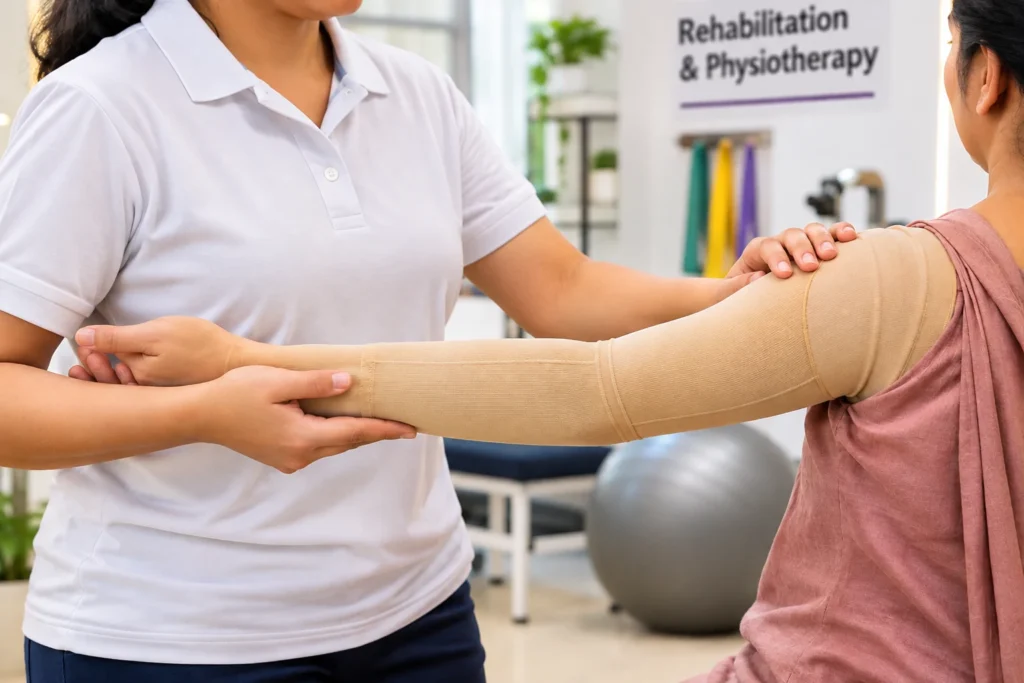
- Physiotherapy and stretching every day – the biggest factor in keeping movement after release.
- Itch and heat care: burn scars often cannot sweat. Moisturise, wear loose cotton, and avoid peak summer heat.
- Emotional support: it is normal to find this hard. Counselling and support groups help.
Children with burn scars
Scalds and kitchen burns are common in young children. Because burn scars do not stretch as a child grows, tight scars can pull joints and even affect bone growth. Children are often treated earlier, and some need more than one release as they grow. Pressure garments and play-based physiotherapy are especially important.
What happens on the day
- Assessment: movement, scar maturity, donor skin and your priorities. Photographs and measurements of joint movement.
- Planning: most people need a staged plan over months or years.
- Anaesthesia: small releases may be done under local anaesthetic; larger ones under general anaesthetic in hospital.
- After surgery: dressings, splints and early physiotherapy.
Recovery
When | What to expect |
Days 5-7 | First dressing check; graft take assessed |
Weeks 2-3 | Grafts settled; splint and gentle movement begin |
Weeks 3-6 | Pressure garments and physiotherapy increase |
Months 6-12 | Grafts and scars mature and soften |
Results timeline
Movement often improves straight after release, but keeping it depends on splints and physiotherapy. Grafts and scars settle over 6 to 12 months. Most people need several stages over one to three years.
Burn reconstruction cost in Ahmedabad
Cost depends on how many areas need treatment, the technique, whether a hospital stay is needed, and how many stages are planned. For reference, India’s PM-JAY scheme lists functional post-burn contracture surgery at around Rs 50,000-60,000 per joint, including splints, pressure garments, silicone and physiotherapy.
Treatment | Approximate cost in Ahmedabad |
Consultation | Contact Our Clinic |
Contracture release with graft – per area | Contact Our Clinic |
Z-plasty / local flap release | Contact Our Clinic |
Tissue expansion – per stage | Contact Our Clinic |
Fractional CO2 laser for burn scars – per session | Contact Our Clinic |
Fat grafting | Contact Our Clinic |
Pressure garments | Contact Our Clinic |
Government schemes, insurance and acid attack survivors
- PM-JAY and MA Yojana: Cover functional post-burn surgery at empanelled hospitals.
- Insurance: Reconstruction to restore function after an accident is often covered; cosmetic scar work usually is not.
- Workplace burns: Employer compensation may apply.
Acid attack survivors: under Supreme Court directions, survivors in India are entitled to free treatment, including reconstructive surgery, in government and private hospitals. If this applies to you or someone you support, please contact us directly. |
When an old burn scar needs checking
If a wound in an old burn scar will not heal, keeps breaking down, bleeds, or develops a raised or crusted edge, have it examined. Rarely, long-standing burn scars develop a skin cancer called a Marjolin’s ulcer, often many years later. It is uncommon and very treatable when found early. |
Frequently Asked Question
Start Today
Ready to Get Started?
Book a complimentary consultation to discuss your goals and receive a personalised treatment plan.