
Gynecomastia Surgery in Ahmedabad, Gujarat (Male Breast Reduction)
Written and medically reviewed by Dr Arth Shah, MBBS, MS (General Surgery), MCh (Plastic & Reconstructive Surgery). Gujarat Medical Council registration G-25994. MCh from B.J. Medical College, Ahmedabad (2017). Practising in Ahmedabad since 2018.

Gynecomastia surgery removes the firm glandular tissue and surrounding fat that make a man’s chest look like it has breasts. At Rejuva Aesthetica in Ahmedabad it is done as a day-care procedure, usually takes 60 to 90 minutes, and most men go home the same evening. Cost in Ahmedabad typically runs Rs 50,000 to Rs 1,00,000 depending on grade, rising for Grade 3 and revision cases. Desk work is realistic in 3 to 5 days; gym at 4 to 6 weeks. Results are permanent provided weight stays stable and anabolic steroids are avoided.
You have probably already tried the gym. Months of incline press, a diet you actually stuck to, maybe a fat burner someone at the gym swore by. The stomach went. The chest did not. That is usually the tell. Fat responds to a calorie deficit. Breast gland does not. If you can pinch a firm, rubbery disc sitting directly under the nipple – something that feels distinctly different from the softer tissue around it – that is glandular tissue, and no amount of training will move it. It has to be taken out.
This is more common than most men assume. Published prevalence estimates put gynecomastia somewhere between a third and two-thirds of adult men, and in the large majority of cases no underlying cause is ever identified. It is medically harmless. It is also, for a lot of men, the reason they have not taken a shirt off in public since school, the reason they wear two t-shirts to the gym, and the reason they picked a swimming pool over a beach holiday.
At Rejuva Aesthetica in Jodhpur, Ahmedabad, Dr Arth Shah has been correcting male chests. This page covers what the operation actually involves, what it costs in Gujarat, how long you are genuinely out of action, how to tell whether you need gland excision or just liposuction, and what a poor result looks like so you can recognise one.
What gynecomastia actually is - and what it is not
Gynecomastia is the growth of real breast gland tissue in men, driven by the balance between oestrogen and testosterone tipping towards oestrogen. It is not the same thing as being overweight, and it does not respond to weight loss, because gland is not fat. Getting this distinction right matters, because it decides whether you need liposuction, gland removal, or both.
True gynecomastia vs pseudogynecomastia (male chest fat)
Three things can make a male chest look enlarged, and they are treated differently.
|
What it is |
How it feels |
What actually works |
|
True glandular gynecomastia |
A firm, rubbery, coin-to-saucer sized disc directly behind the nipple. Often tender. Sometimes only on one side. |
Surgical excision of the gland. Liposuction alone will not remove it and can make it look worse by taking the fat around it away. |
|
Pseudogynecomastia (male chest fat) |
Soft and even throughout, no distinct lump, moves with the rest of your body fat. Gets better when you lose weight. |
Weight loss first. If it persists at a stable weight, chest liposuction. |
|
Mixed – the most common presentation |
A firm core under the nipple with a soft fatty envelope around it. |
Liposuction to debulk and feather the edges, plus excision of the gland core. This is the majority of cases we operate on. |
The pinch test you can do at home. Lie flat on your back. Place thumb and index finger wide apart on either side of the nipple and slowly bring them together. If you feel a distinct firm edge or disc that stops your fingers before they meet, that is gland. If the tissue compresses smoothly all the way, it is more likely fat. This is not a diagnosis – it is a reasonable indicator of which conversation to have.
A firm lump in the male chest is not always gynecomastia. It can be a lipoma, a cyst, or – rarely but importantly – male breast cancer, which is why an examination and, where indicated, an ultrasound comes before any surgical planning. A hard, fixed, irregular lump that is off-centre from the nipple, or any nipple discharge or skin change, is examined and investigated before anything else is discussed.
The four grades of gynecomastia, and why your grade decides your surgery
Surgeons grade gynecomastia by how much tissue is present and whether the skin has stretched. The grade determines the technique, the scar, the recovery and the price. Most Indian patients we see are Grade 1 or Grade 2.
|
Grade |
What it looks like |
Usual approach |
Scar |
|
Grade 1 |
Small enlargement confined to the area behind the nipple. No excess skin. This is what most men call “puffy nipples”. |
Gland excision through a small incision at the lower edge of the areola, often with a little liposuction to blend the edges. |
A thin line hidden at the areolar border. Usually hard to find after a few months. |
|
Grade 2a |
Moderate enlargement across the chest. Skin still tight. |
Liposuction plus gland excision. |
Areolar border incision plus 3-4 mm liposuction ports, usually in the fold or armpit. |
|
Grade 2b |
Moderate enlargement with the first signs of loose skin at the lower pole. |
Liposuction plus gland excision, with skin tightening. Occasionally a small skin reduction. |
Areolar border, sometimes extended. |
|
Grade 3 |
Marked enlargement with clearly redundant, hanging skin – close to a female breast shape. Common after major weight loss. |
Liposuction and excision plus formal skin reduction, and sometimes repositioning or reduction of the nipple-areola complex. |
A longer, planned scar. Traded deliberately for chest shape – this is a discussion, not a surprise. |
Benefits of gynecomastia surgery
The main benefits are a permanently flatter chest contour, clothes that fit the way they are supposed to, and the end of the daily management most men with gynecomastia are doing without telling anyone. It is a one-time procedure with a short recovery and results that do not need maintenance.
- A flat, masculine chest contour. The gland is removed, not compressed or hidden. The change is visible from the day the swelling settles.
- It is permanent. Removed gland does not grow back. What can change the result is significant weight gain or a return to anabolic steroids – both of which are within your control.
- No more compensating. Layering shirts, avoiding the pool, sitting differently, crossing your arms in photographs. Most patients describe stopping these things as the actual benefit, more than the mirror.
- Very small scars in most grades. Grade 1 and 2 cases are done through an incision at the areolar border and liposuction ports of 3 to 4 mm.
- Day-care. Out. Home the same evening. No overnight admission for standard cases.
- Chest pain and tenderness usually settle. Where the gland was tender, removing it generally resolves that.
- Training gets easier and more rewarding. Chest work stops making the problem more obvious, which for men who lift is often the most frustrating part of the condition.
- It can be combined. If you are also dealing with flank or upper-abdominal fat, that can be addressed in the same sitting – see the treatments menu below.
Areas treated during male chest contouring
A gynecomastia operation treats the whole chest unit, not just the lump. Correcting the gland without blending the surrounding areas is the most common cause of a chest that looks operated on rather than natural.
|
Area |
Why it is treated |
|
Subareolar region (directly behind the nipple) |
Where the glandular disc sits. The primary target in every case. |
|
Nipple-areola complex |
A stretched or puffy areola often needs reducing or flattening. Leaving it untouched is why some results still look wrong after the gland is gone. |
|
The pectoral fat pad |
Debulked and feathered with liposuction so the chest reads as a single smooth plane rather than a crater with a rim. |
|
Lateral chest and axillary tail |
The roll that spills towards the armpit and shows in a fitted t-shirt. Ignoring it is the most common omission in a cheap gynecomastia job. |
|
Inframammary fold (the crease under the chest) |
Softened so the chest blends into the ribcage instead of ending in a shelf. |
|
Anterior axillary fold and accessory breast tissue |
Where present. See axillary breast and lipoma treatment. |
|
Upper abdomen and flanks |
Optional, same sitting. Often necessary for a proportionate torso in post-weight-loss cases. See liposuction. |
Conditions and cases we treat
Not every enlarged male chest is the same problem. These are the presentations seen most often at the clinic, and what each one usually needs.
- Persistent pubertal gynecomastia. Started around 12 to 16 and never went away. Most adolescent gynecomastia resolves on its own within 12 to 24 months, which is why we generally advise waiting that period out before operating on a teenager.
- Adult-onset idiopathic gynecomastia. Appeared with no obvious trigger. The largest single group.
- Steroid and supplement-induced gynecomastia. Anabolic steroids, prohormones and some testosterone boosters aromatise to oestrogen. This one has its own section below.
- Drug-induced gynecomastia. Spironolactone, some antihypertensives, anti-androgens used in prostate treatment, certain antidepressants and antipsychotics, cimetidine and others. If a medication may be the cause, that is discussed with your prescribing doctor before surgery is planned – see blood pressure medication and gynecomastia.
- Pseudogynecomastia – pure male chest fat. Treated with liposuction once your weight is stable, or with weight loss first if it is not.
- Post-weight-loss chest. The gland and fat have gone but the skin has not retracted. Needs a skin-tightening or skin-excision approach, not just liposuction.
- Unilateral or asymmetric gynecomastia. One side larger than the other. Common, and usually operated on both sides for symmetry even when only one is obviously affected.
- Gynecomastia with an underlying endocrine cause. Hypogonadism, thyroid disease, liver or kidney disease, Klinefelter syndrome, rarely a hormone-secreting tumour. These are investigated and referred appropriately before any surgery is scheduled. See whether gynecomastia runs in families.
- Gynecomastia with lifestyle contributors. Alcohol, cannabis, obesity, some herbal supplements. See lifestyle causes of gynecomastia.
Puffy nipple correction
A “puffy nipple” is usually Grade 1 gynecomastia: a small glandular disc that pushes the areola forward into a cone, most obvious through a t-shirt or after a shower. It is the least invasive version of this operation – a small incision at the lower areolar border, the disc removed, a little liposuction to blend, and a scar that generally disappears into the areolar edge.
Dedicated page: puffy nipple gynecomastia surgery. Where the areola itself is stretched, it can be reduced at the same time – see nipple and areola correction and inverted nipple surgery.
Steroid-induced and bodybuilder gynecomastia
Anabolic steroids convert to oestrogen in the body, and the gland tissue that forms as a result does not disappear when you stop the cycle. Surgery removes it. But if you return to the same compounds without aromatase management, new gland can form in the residual tissue. That conversation happens before the operation, not after.
We treat competitive and recreational lifters regularly. Two practical points: chest training stops for six weeks minimum, and the result looks better on a lean chest, so the timing relative to your training block is worth planning.
Revision surgery after a failed gynecomastia operation
Revision gynecomastia surgery corrects the result of a previous operation – most often residual gland that was never fully removed, a crater or saucer deformity where too much tissue was taken from directly under the nipple, a nipple stuck down to the muscle, visible asymmetry, or contour ridges from uneven liposuction.
This is difficult surgery. Scar tissue changes the planes, the blood supply to the nipple has already been disturbed once, and the margin for error is smaller. It usually needs a combination of secondary excision, fat grafting to fill contour defects, scar release and careful re-draping. It also generally costs more than a primary procedure, and there is a minimum interval – normally six months from the first operation – before revising.
Dr Shah has managed revision cases referred from outside Gujarat, including a documented correction of a gynecomastia surgery performed in Rajasthan. See patient video testimonials.
Every gynecomastia treatment available at Rejuva Aesthetica
Rejuva Aesthetica is a full plastic and cosmetic surgery unit, not a single-machine clinic, so the technique is chosen to fit the chest rather than the other way round. Below is the complete range used for male chest correction.
Fat removal techniques
- Tumescent liposuction. The baseline. Dilute local anaesthetic and adrenaline infiltrated first, which reduces bleeding and bruising and makes the fat easier to remove evenly.
- Power-assisted liposuction (PAL). An oscillating cannula that works better through the fibrous, dense fat typical of a male chest.
- VASER / ultrasound-assisted liposuction. Ultrasound energy emulsifies fat before removal and is well suited to fibrous chest tissue and to secondary cases. Often marketed as “laser gynecomastia surgery” by other clinics – it is worth understanding that the energy device assists the liposuction, it does not replace the removal of gland.
- Laser-assisted liposuction.
Gland removal techniques
- Subcutaneous mastectomy through a periareolar (Webster) incision. The standard method of removing the glandular disc, through an incision along the lower half of the areolar border.
- Pull-through / minimal-access gland extraction. The gland is delivered through a liposuction port rather than a formal incision, in suitable Grade 1 and small Grade 2 cases. Smaller scar, but only appropriate for certain tissue types.
- Deliberate retention of a thin retro-areolar disc. A technical point that matters more than it sounds: leaving a few millimetres of tissue under the nipple is what prevents the crater deformity you see in badly done cases.
Skin and nipple work
- Radiofrequency-assisted skin tightening. For Grade 2b chests with mild laxity, as an alternative to a skin-excision scar.
- Circumareolar (donut / Benelli) skin reduction. For moderate skin excess, tightening the skin envelope through a scar that stays at the areolar border.
- Vertical or inframammary skin excision. For Grade 3 chests where a circumareolar approach will not take up enough skin.
- Nipple-areola reduction and repositioning. Reducing a stretched areola and moving the nipple to a masculine position on the chest wall.
- Free nipple grafting. Reserved for the most severe post-massive-weight-loss chests. Rare, and always discussed in detail beforehand.
Adjunct and combined procedures
- Fat grafting for contour correction. Mainly in revision cases, to fill a crater or a step-off.
- Excision of accessory axillary breast tissue in the same sitting.
- Combined chest with flank and upper-abdominal liposuction for a proportionate torso.
- Combined with tummy tuck or arm and thigh lift in post-weight-loss body contouring.
- Scar management. Silicone gel or sheeting, and where indicated intralesional steroid for hypertrophic scars – relevant for Indian skin types, which scar differently from the skin types in most international guidance.
Assessment and non-surgical management
- Clinical grading and examination, including exclusion of a suspicious lump.
- Chest ultrasound where the diagnosis is not clinically obvious; mammography where indicated.
- Hormone panel and endocrine referral where a treatable underlying cause is suspected – testosterone, LH, FSH, prolactin, oestradiol, thyroid and liver function as clinically appropriate.
- Medication review with your treating doctor, where a drug is the likely cause.
- Watchful waiting for adolescents inside the first 12 to 24 months, and weight optimisation for pure pseudogynecomastia. Not every chest needs an operation, and saying so is part of the assessment.
The full range of body procedures is on our body contouring page
The gynecomastia surgery procedure, step by step
From walking in to walking out is usually four to five hours on the day, of which 60 to 90 minutes is the actual operation. Here is the whole sequence, including the parts that happen before and after the day itself.
Step 1 – Consultation and grading
Examination standing and lying down, on both sides. The gland is felt for, the skin quality assessed, the grade assigned, and photographs taken from five standard angles for your record. This is also where asymmetry gets measured, because almost every chest is slightly asymmetric and it is better to point that out before surgery than to discover it afterwards.
Step 2 – Investigations
Routine pre-operative blood work: complete blood count, blood sugar, coagulation profile, viral markers, and an ECG where age or history warrants it. A chest ultrasound if the lump is atypical, and a hormone panel if the history suggests an endocrine cause. If a treatable cause turns up, that gets addressed first.
Step 3 – Planning and consent
Technique, incision placement, expected scar, realistic outcome, risks, cost and recovery are all covered and written down. You should leave this appointment knowing exactly where your scars will be. If you do not, ask again.
Step 4 – Pre-operative preparation
- Stop smoking at least two to four weeks before. Nicotine constricts the small vessels that keep the nipple alive after gland removal – this is not a generic health lecture, it is specific to this operation.
- Stop blood thinners, aspirin, fish oil, vitamin E and most herbal supplements as instructed.
- Stop anabolic steroids and prohormones.
- Six hours nil by mouth before general anaesthesia.
- Arrange someone to take you home. You will not be driving.
Step 5 – Marking
Done with you standing, before any anaesthesia, because tissue moves once you lie down. The gland edge, the areas to be feathered, the port sites and the inframammary fold all get drawn on.
Step 6 – Anaesthesia
Usually general anaesthesia for comfort, or local anaesthesia with sedation for small Grade 1 cases. Both are day-care. The choice is made with the anaesthetist based on the extent of surgery and your medical history.
Step 7 – Tumescent infiltration
Dilute anaesthetic solution is infiltrated through the treatment area. It reduces bleeding, reduces bruising, and lifts the tissue planes apart so the liposuction is cleaner.
Step 8 – Liposuction
Through 3 to 4 mm ports placed at the lateral chest or in the fold, where the marks hide. The fatty component is removed and the edges feathered into the surrounding chest so there is no visible step.
Step 9 – Gland excision
The glandular disc is removed through a small incision at the lower areolar border. A thin layer is intentionally left beneath the nipple to preserve blood supply and prevent a depression. The specimen is sent for histopathology – standard practice, and the correct answer to “how do you know it was not something else”.
Step 10 – Symmetry check and closure
You are sat up on the table and both sides compared before closing. Correcting a difference now takes two minutes; correcting it later takes a second operation. Closure with fine absorbable sutures. Drains are not routine but are used for large Grade 3 excisions.
Step 11 – Compression garment
Fitted before you leave the table. The garment does real work: it controls swelling, holds the skin against the chest wall while it re-adheres, and reduces the risk of fluid collection. Skipping it is the most common reason a good operation produces a mediocre result.
Step 12 – Discharge and follow-up
Home the same evening for standard cases, with medication and written instructions. Follow-ups with photographs at each visit.
Recovery and downtime after gynecomastia surgery
Most men are up and walking the same evening, back at a desk job in 3 to 5 days, driving in about a week, doing light cardio at 2 to 3 weeks and back to full chest training at 6 weeks. The compression garment is worn day and night for the first 3 to 4 weeks. Discomfort is usually described as soreness and tightness rather than sharp pain, and is managed with simple oral analgesia.
|
When |
What you can do |
What to expect |
|
Day 0 (surgery day) |
Walk around the house. Eat normally once nausea settles. |
Tightness across the chest, grogginess from anaesthesia. Garment on. |
|
Day 1-2 |
Self-care, light movement, work from home if your job is sedentary. |
Peak soreness and swelling. Some bruising appears. First dressing check. |
|
Day 3-5 |
Return to a desk job. Short walks. |
Soreness easing noticeably. Swelling still obvious – the chest will not look “done” yet. |
|
Day 7-10 |
Driving, provided you are off strong painkillers. Sutures reviewed. |
Bruising fading. Numbness around the nipple is normal and usually temporary. |
|
Week 2-3 |
Light cardio – walking, cycling, treadmill. No chest, no shoulders, no lifting above 5 kg. |
Swelling settling. Shape starting to emerge. |
|
Week 4 |
Garment often steps down to daytime only. |
Most of the obvious swelling gone. Scars may look pink and firm – this is the normal course. |
|
Week 6 |
Full gym including chest and heavy lifting, on clearance. |
Contour close to final. Residual firmness under the areola is common. |
|
Month 3 |
No restrictions. Swimming, sun, everything. |
Scars softening and fading. Numbness resolving. |
|
Month 6-12 |
– |
Scars mature to their final appearance. Final contour assessment and photographs. |
More detail on rest and time off: how much rest you need after gynecomastia surgery.
When to call the clinic immediately
- Rapid one-sided swelling, especially in the first 48 hours – this can be a haematoma and it is time-critical.
- Fever above 38 C, spreading redness, or discharge from an incision.
- The nipple turning dusky, grey or white.
- Calf pain or breathlessness.
Gynecomastia surgery cost in Ahmedabad, Gujarat
Gynecomastia surgery in Ahmedabad generally costs between Rs 50,000 and Rs 1,00,000 for a standard Grade 1 to Grade 2 case. Grade 3 cases needing skin excision, and revision surgery correcting a previous operation, cost more. The single biggest variable is your grade, followed by whether gland excision alone is enough or skin work is also required.
|
Case type |
Typical range (both sides) |
What is involved |
|
Grade 1 / puffy nipple |
Rs 50,000 – 65,000 |
Gland excision with limited liposuction. Shortest procedure. |
|
Grade 2a |
Rs 65,000 – 85,000 |
Liposuction plus gland excision. |
|
Grade 2b |
Rs 80,000 – 1,00,000 |
Liposuction, gland excision, skin tightening. |
|
Grade 3 |
Rs 1,00,000 – 1,35,000 |
Liposuction, excision, formal skin reduction, sometimes nipple repositioning. |
|
Revision surgery |
From Rs 1,10,000 |
Longer, technically harder, often needs fat grafting. |
|
Unilateral (one side) |
Approx. 15-20% less |
Rarely advised on its own – symmetry usually requires addressing both sides. |
|
Combined with flank or abdominal liposuction |
Contact our clinic |
Costs less than doing the two procedures separately. |
What the price includes, and what it does not
|
Included |
Charged separately |
|
Surgeon’s fee |
Initial consultation |
|
Anaesthetist’s fee |
Pre-operative blood work and ECG |
|
Operating theatre and day-care charges |
Chest ultrasound (approximately Rs 600 – 1,500) |
|
Consumables, sutures and dressings |
Hormone panel, where indicated (approximately Rs 1,500 – 4,000) |
|
First compression garment |
A second garment, if you want a spare |
|
Post-operative medication for the first days |
Histopathology |
|
Scheduled follow-up visits |
Scar treatment products |
|
– |
Revision, if required, outside the clinic’s stated policy |
Why quotes differ so much between clinics
You will get quotes ranging from Rs 30,000 to over Rs 2,00,000 in the same city. The gap is usually explained by four things: whether a qualified plastic surgeon with an MCh is operating or a general practitioner is, whether the setting is an accredited operating theatre or a procedure room, whether the quote covers only liposuction or also gland excision, and whether follow-up and garments are bundled or billed later. Ask any clinic to itemise. An unusually cheap gynecomastia quote is very often liposuction alone, which leaves the gland behind.
A full component-by-component breakdown is on our dedicated gynecomastia surgery cost in Ahmedabad page.
Is gynecomastia surgery covered by insurance in India?
Usually not. Indian health insurers classify gynecomastia surgery as cosmetic by default and exclude it. Cover is occasionally granted where the condition is documented as symptomatic or pathological – persistent pain, a diagnosed endocrine cause, or a suspicious lump requiring excision – and where the insurer accepts pre-authorisation. Approval is decided case by case by the insurer, not by the clinic.
What we can do is provide the clinical documentation – examination findings, ultrasound, hormone results and operative notes – for you to submit. What we cannot do is promise an outcome from your insurer. Any clinic telling you cover is guaranteed is telling you something it does not control.
Results timeline: what your chest looks like, week by week
You will see a change immediately, but not the final result. The chest is flatter on day one and then swells; the shape re-emerges over the first month, is largely settled by month three, and finishes maturing – mostly in the scars – between six and twelve months.
|
Stage |
What the chest looks like |
|
Immediately after surgery |
Visibly flatter under the garment, but swollen and tight. Do not judge anything yet. |
|
Week 1 |
Swelling and bruising at their most obvious. Some men feel the chest looks worse than before. This is expected and it passes. |
|
Week 2-4 |
Bruising resolves, swelling drops substantially. The new contour starts to show. Firmness under the areola is normal – it is healing tissue, not returning gland. |
|
Week 6-8 |
Roughly 70-80% of the final result. Most men are comfortable in a fitted t-shirt at this point. |
|
Month 3 |
Contour essentially final. Scars still pink or darker than surrounding skin, which is normal on Indian skin tones. |
|
Month 6 |
Scars flattening and fading. Any residual numbness is usually gone. |
|
Month 12 |
Final scar appearance. This is the honest point at which to judge the result – and the point at which our comparison photographs are taken. |
Comparison photographs from real cases, with grade and interval labelled, are in the before-and-after results gallery
How the options compare
Liposuction alone vs liposuction with gland excision
Liposuction removes fat. It does not remove glandular tissue, because gland is too fibrous to pass through a cannula. If you have true gynecomastia and only have liposuction, the firm disc stays behind – and with the fat around it gone, it can actually become more prominent. This is the most common reason men need revision surgery.
|
|
Liposuction only |
Liposuction + gland excision |
Excision + skin reduction |
|
Right for |
Pseudogynecomastia – fat only, no gland |
Grade 1 to 2b – the large majority of cases |
Grade 3, or post-massive-weight-loss |
|
Removes the gland |
No |
Yes |
Yes |
|
Scar |
3-4 mm ports only |
Ports plus a line at the areolar border |
A longer planned scar |
|
Risk of residual lump |
High if gland is present |
Low |
Low |
|
Typical procedure time |
30-45 min |
60-90 min |
2-3 hours |
|
Relative cost |
Lowest |
Mid |
Highest |
Standalone plastic surgery clinic vs surgical aggregator vs med-spa
The three are genuinely different products. An aggregator platform coordinates your surgery across partner hospitals and surgeons. A med-spa or dermatology clinic may offer chest liposuction without a plastic surgeon on site. A standalone plastic surgery clinic means one named surgeon who assesses you, operates on you and follows you up. Which is right depends on what you are optimising for.
|
|
Standalone plastic surgery clinic |
Surgical aggregator platform |
Med-spa / dermatology clinic |
|
Who operates |
The surgeon you consulted, named in advance |
A partner surgeon, often assigned closer to the date |
Varies – confirm the qualification |
|
Continuity of care |
Same surgeon consultation to final follow-up |
Coordinated by a care manager |
Varies |
|
Gland excision capability |
Yes – this is core plastic surgery |
Yes, at partner hospitals |
Often liposuction only |
|
Revision and complication handling |
In-house |
Via the platform |
Usually referred out |
|
Insurance and paperwork support |
Documentation provided |
Typically a strength of the model |
Limited |
|
Price transparency |
Direct quote from the operating surgeon |
Published starting prices |
Varies |
|
Best if you want |
One accountable surgeon and continuity |
Coordination, EMI and paperwork handled |
A minor, fat-only correction |
Surgery vs gym, medication and non-surgical treatments
|
Option |
Does it work? |
Honest assessment |
|
Diet and training |
For fat, yes. For gland, no. |
Worth doing regardless – a leaner chest gives a better surgical result. But it will not remove a glandular disc. |
|
Tamoxifen or aromatase inhibitors |
Sometimes, in early cases |
Can help within roughly the first 6-12 months while gland tissue is still proliferative and tender. Once fibrosis sets in, medication does not reverse it. Prescription only, with side effects, and not something to self-medicate from a gym recommendation. |
|
Stopping the causative drug or steroid |
Sometimes, if caught early |
Established gland usually persists even after the trigger is removed. |
|
Weight loss |
For pseudogynecomastia, yes |
The correct first step if the tissue is soft and even. Not a solution for true gynecomastia. |
|
Fat-freezing and non-invasive fat reduction |
Marginally, for fat only |
Does not touch gland. Multiple sessions, modest change, and it can create irregularity on a chest that later needs surgery. |
|
Compression vests and “gynecomastia shirts” |
No |
Camouflage, not treatment. |
|
Herbal and over-the-counter “gyno” supplements |
No credible evidence |
Some contain undisclosed hormonally active compounds. Avoid. |
|
Surgery |
Yes, definitively, for gland |
The only reliable way to remove glandular tissue. Also the only option with a scar, a recovery and a cost – which is why it should follow an honest assessment, not precede one. |
Risks, and who should not have this surgery
Gynecomastia surgery is a low-risk day-care operation in fit patients, but it is still surgery. The recognised risks are bleeding or haematoma, infection, seroma, temporary or occasionally permanent nipple numbness, asymmetry, contour irregularity, over-resection producing a saucer or crater deformity, poor or hypertrophic scarring, and in rare cases partial loss of nipple tissue. Most are manageable when picked up early, which is what the follow-up schedule is for.
This surgery is usually deferred or declined if:
- You are an adolescent within 12 to 24 months of the gynecomastia appearing, and it is still changing. Many of these resolve without an operation.
- Your BMI is high and the chest is predominantly fatty. Weight loss first produces a better and cheaper result.
- You are on an active anabolic steroid cycle, or intend to resume one.
- There is an untreated underlying cause – hypogonadism, thyroid, liver or kidney disease – that should be managed first.
- You smoke and are unwilling to stop for the peri-operative period.
- There is an unexplained hard or fixed lump that has not been investigated.
- Your weight is currently unstable, or you are mid-way through significant weight loss.
Being told to wait is not a rejection. It is the assessment doing its job.
Your doctor: Dr Arth Shah, MS, MCh (Plastic Surgery)
Skin treatments at Rejuva Aesthetica are overseen by Dr Arth Shah, who completed his MBBS at Gujarat University in 2009, his MS in General Surgery at Sardar Patel University, Vallabh Vidyanagar in 2014, and his MCh in Plastic and Reconstructive Surgery at B.J. Medical College, Ahmedabad in 2017. He is registered with the Gujarat Medical Council under registration number G-25994 and has practised in Ahmedabad since 2018.
Book a skin consultation in Ahmedabad
A consultation takes about 20 minutes. You will be examined, your grade assessed, the technique explained, and given a written quote before you leave. If your case is better served by waiting, by losing weight first, or by seeing an endocrinologist, we will tell you that instead.
Rejuva Aesthetica – Plastic & Cosmetic Surgery Clinic 102, Himalaya Emerald, Besides IOC Petrol Pump, Near Shivranjani Over Bridge, Jodhpur, Ahmedabad, Gujarat 380015 Phone: +91 74360 00990 | 079 2692 9299 Monday to Saturday, 9:00 AM to 7:00 PM. Closed Sundays and public holidays. |
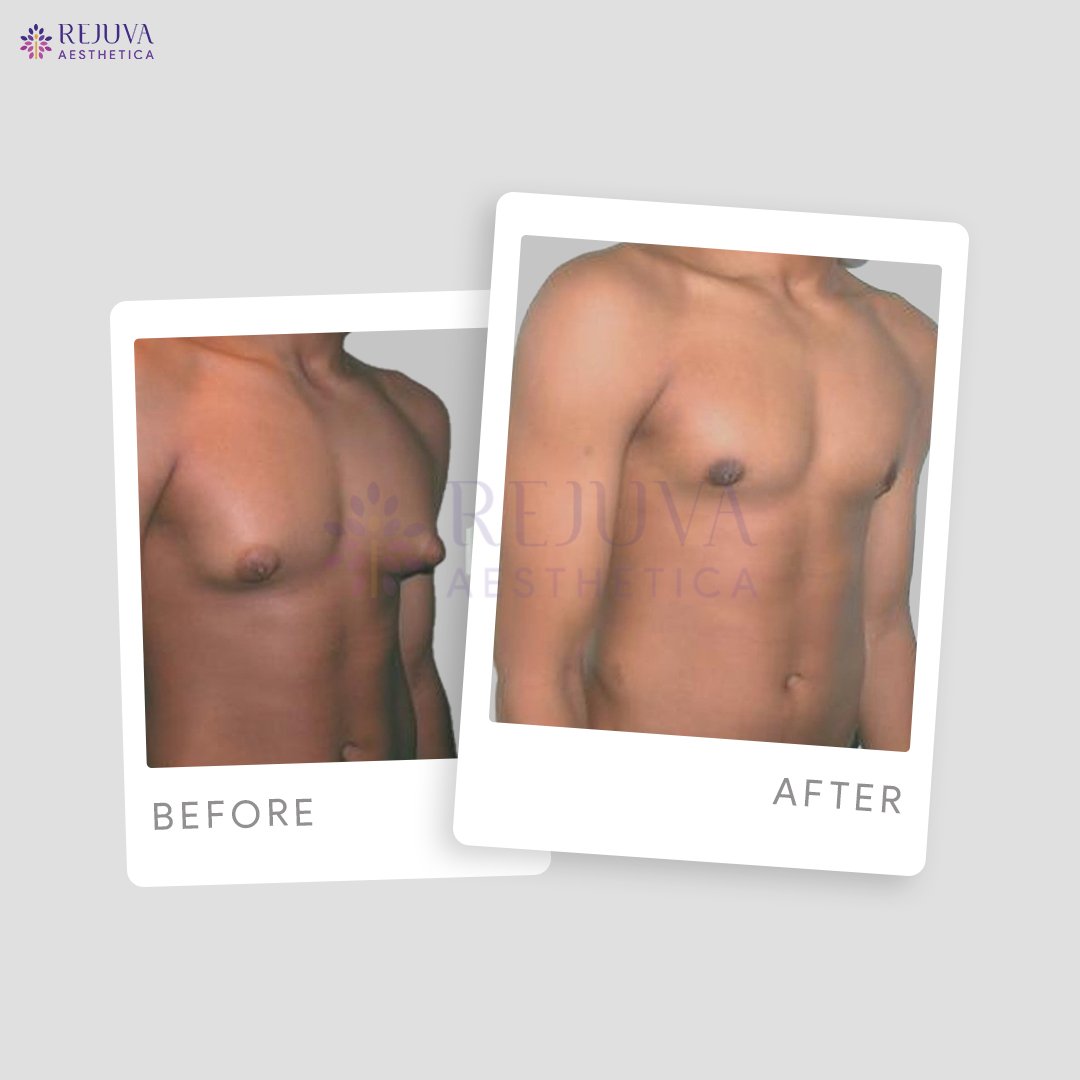
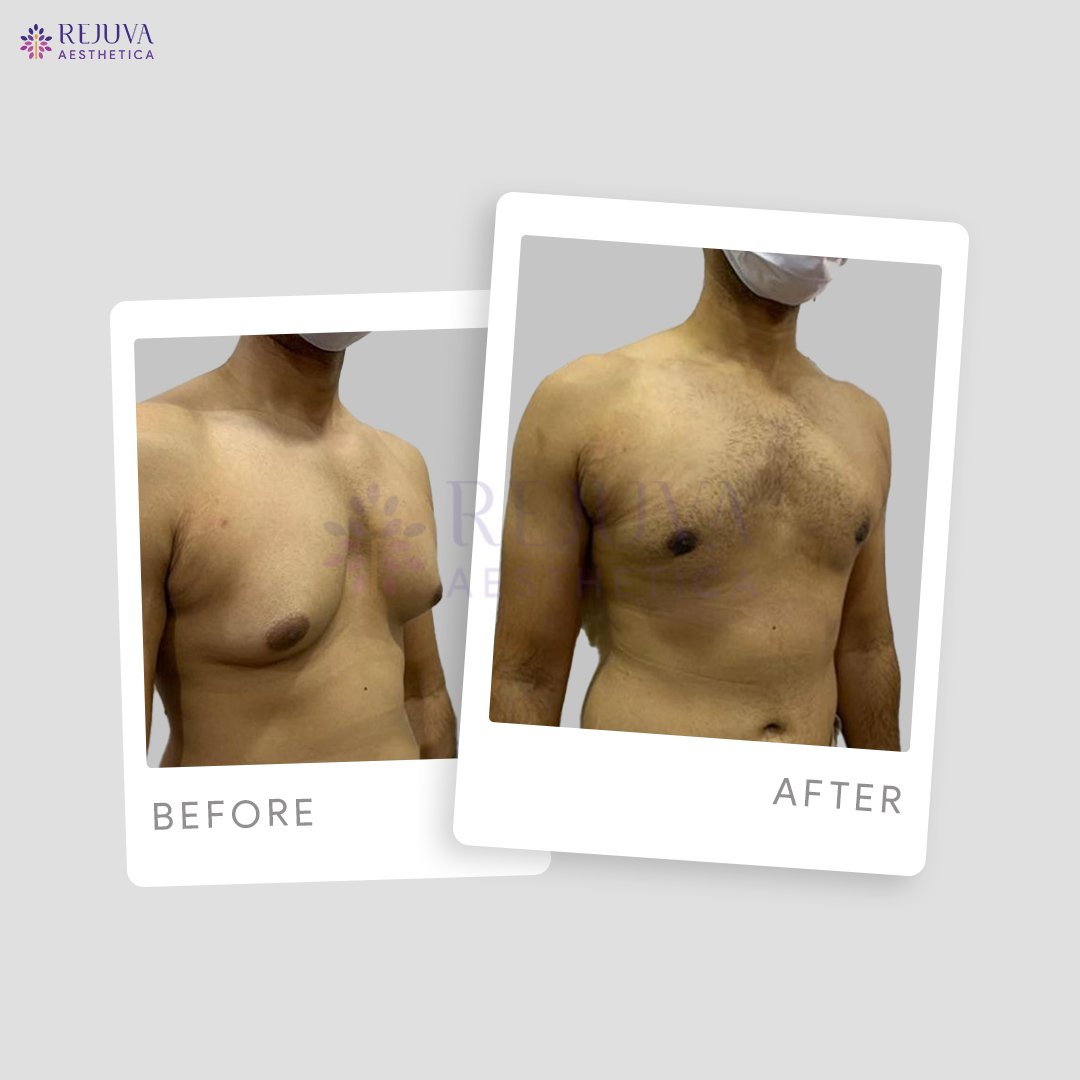
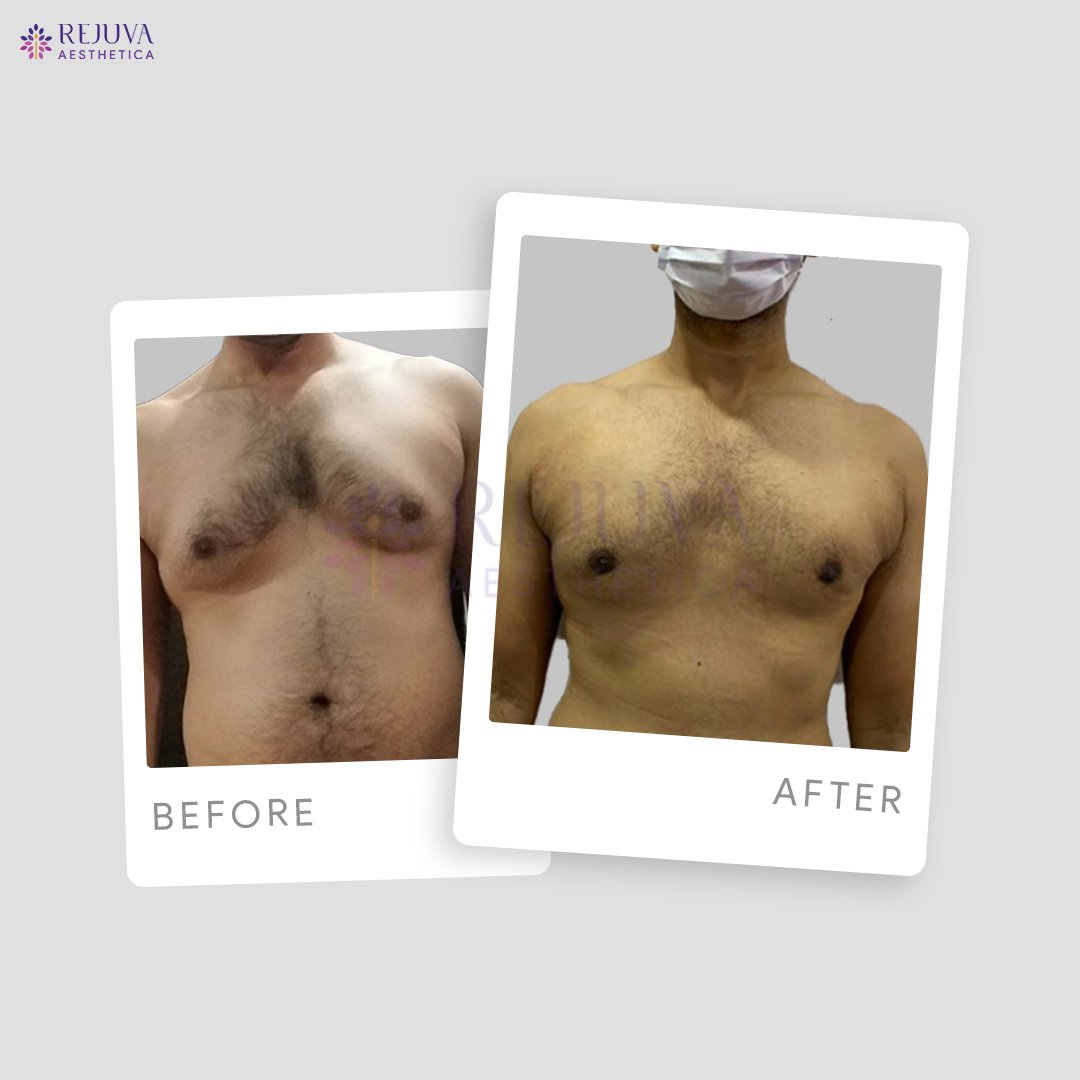
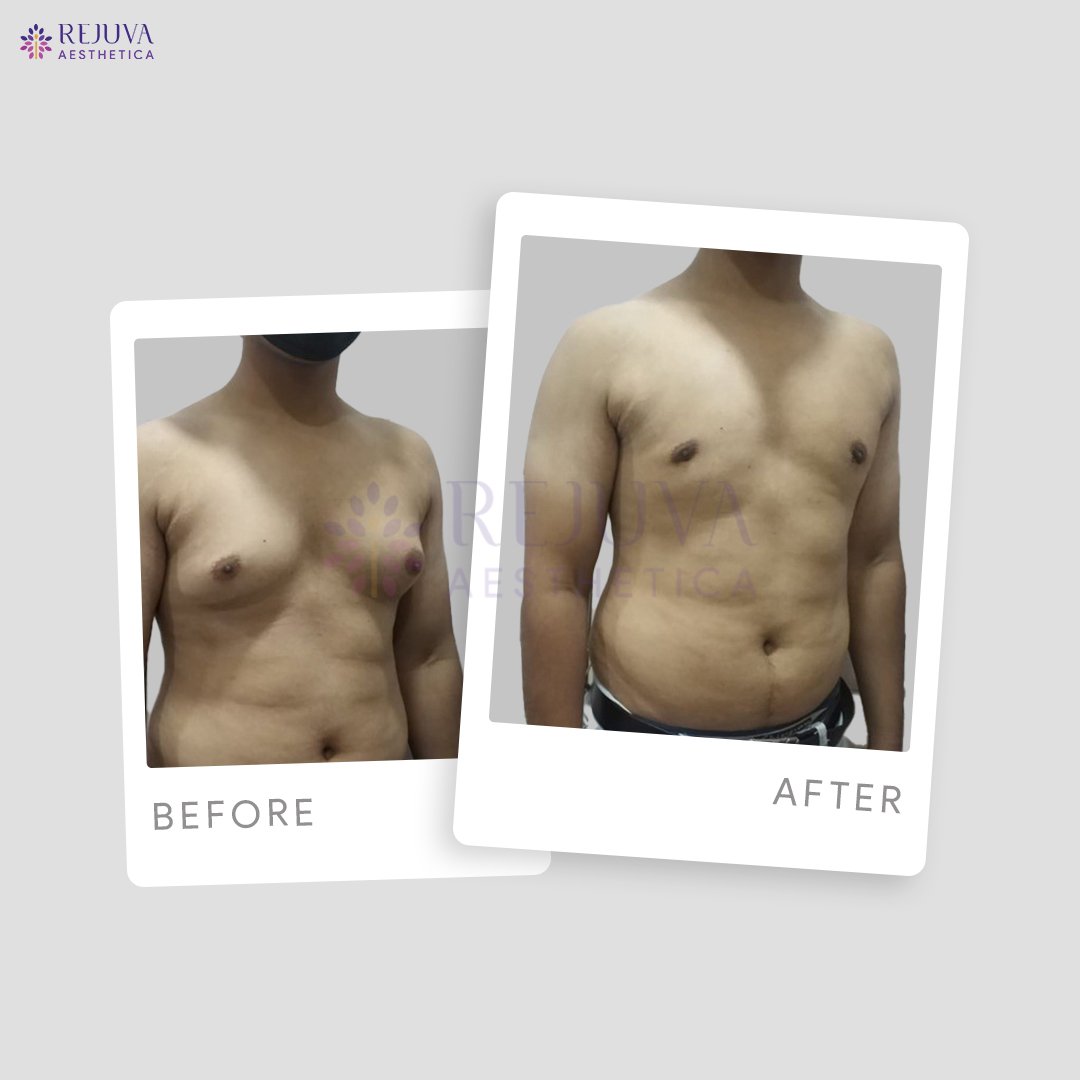
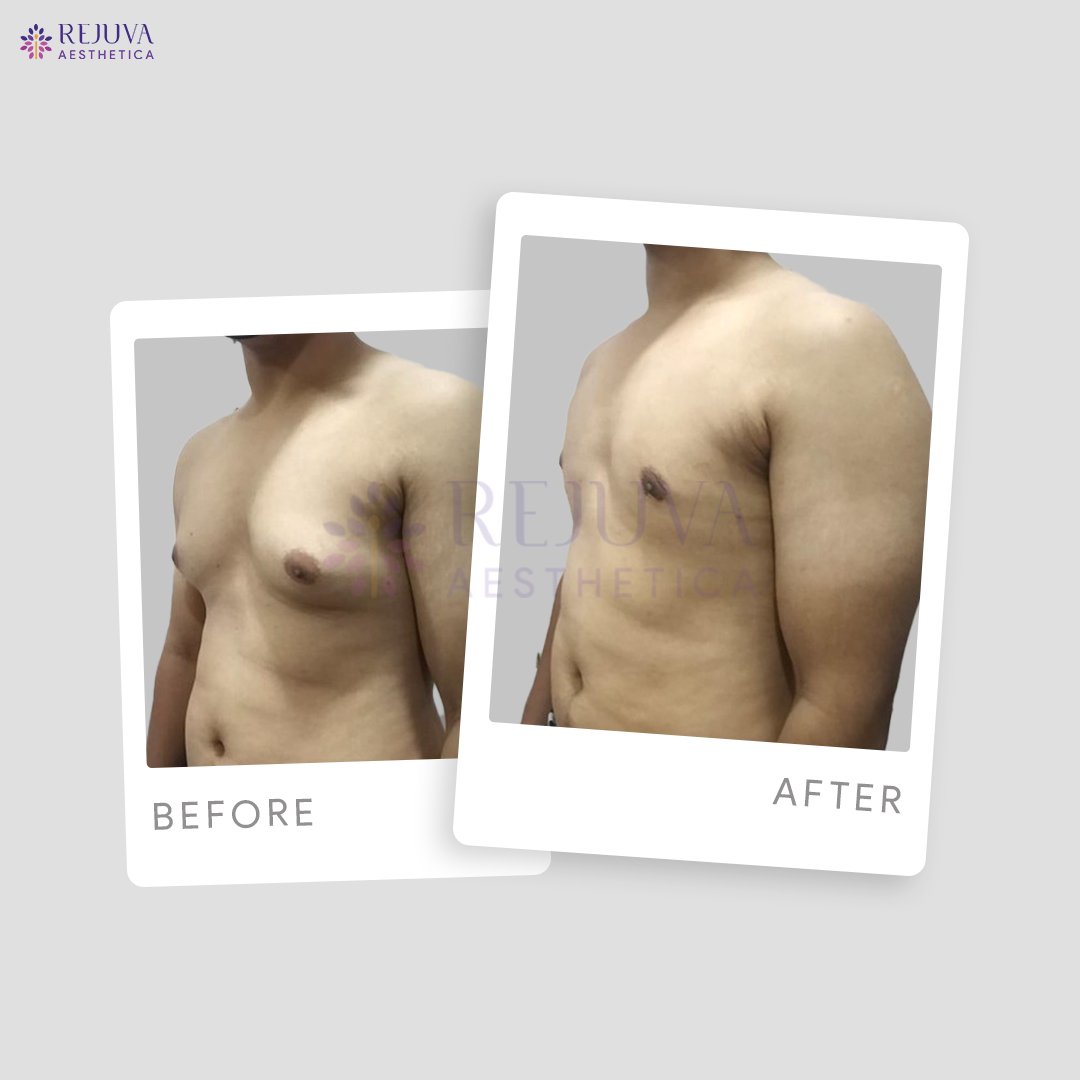
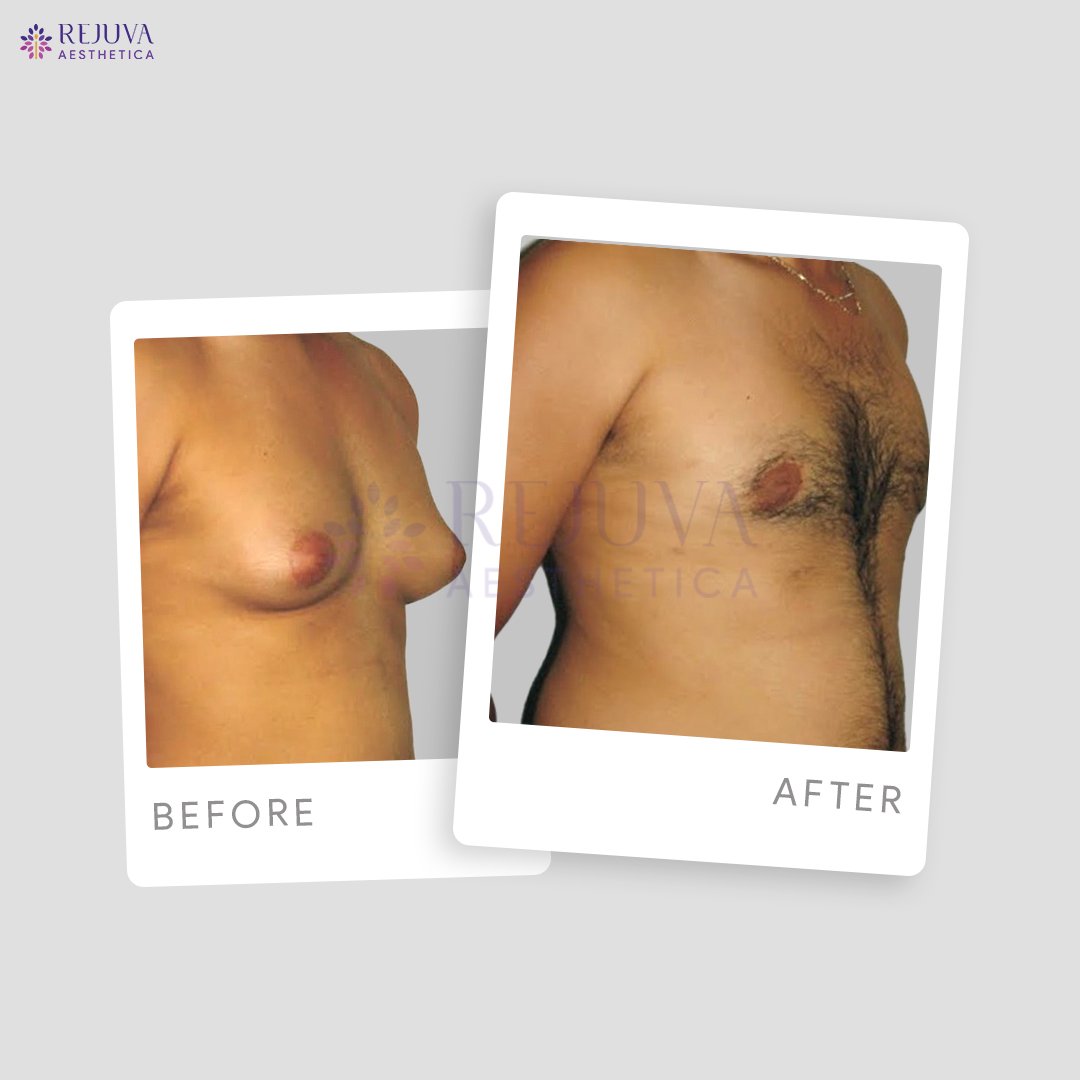
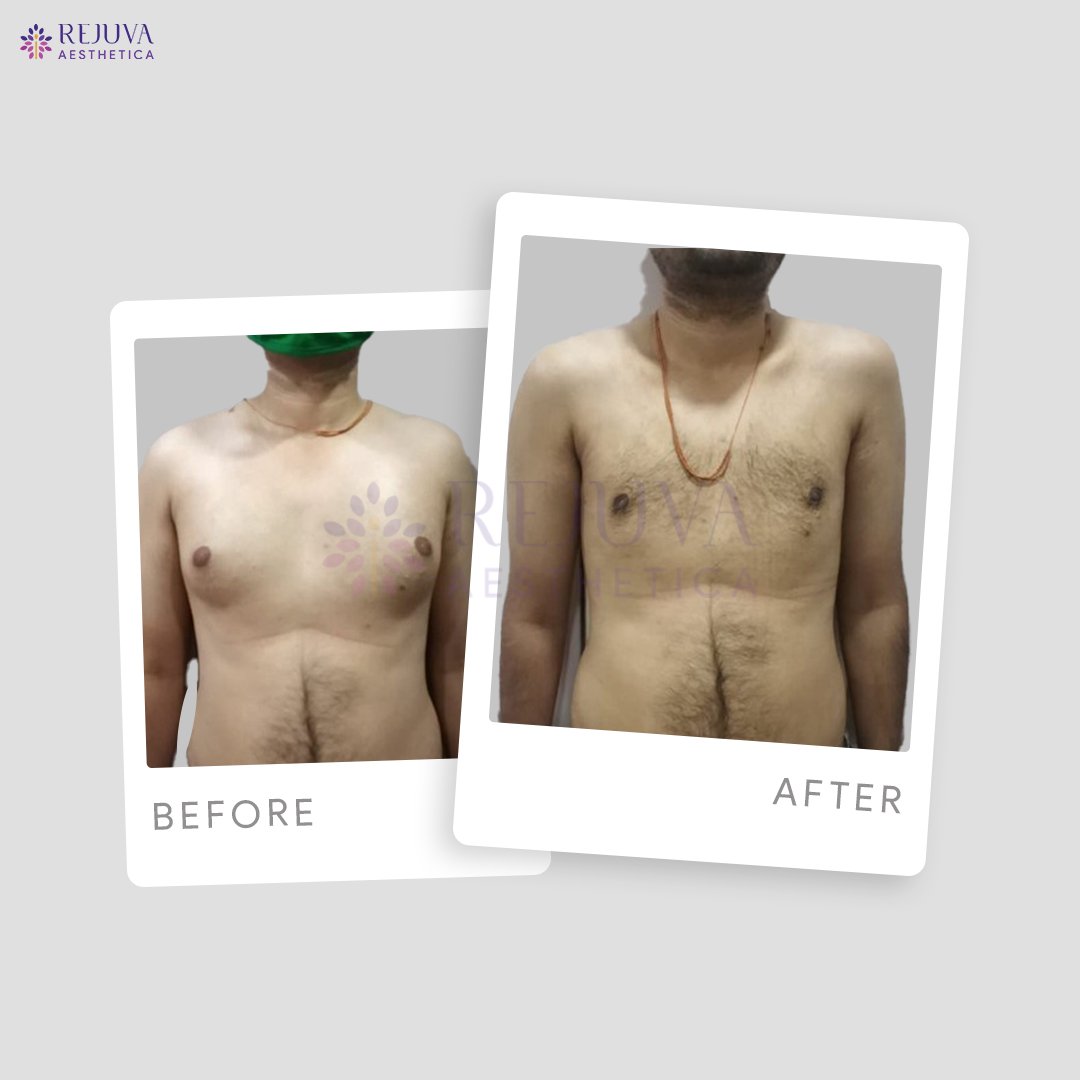
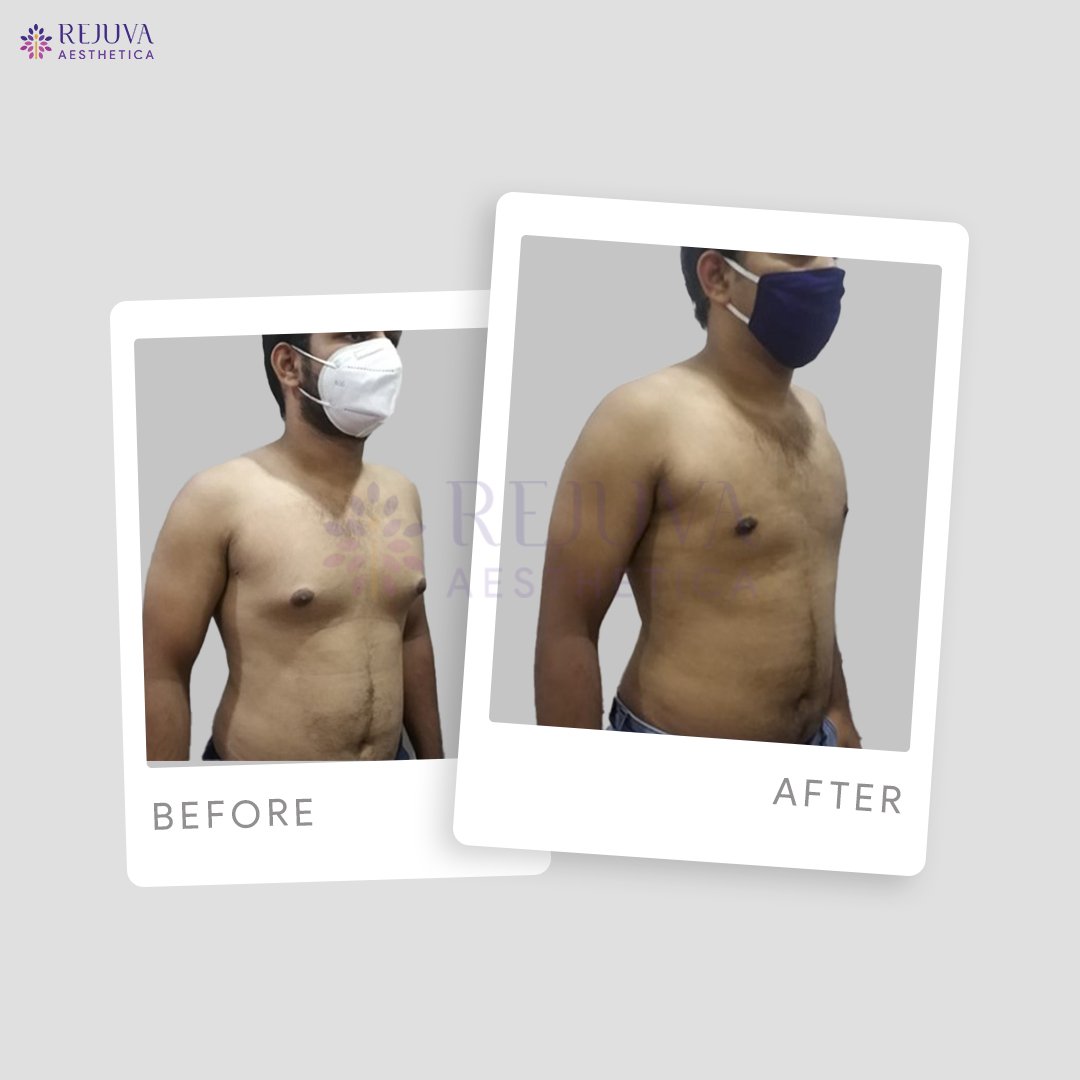
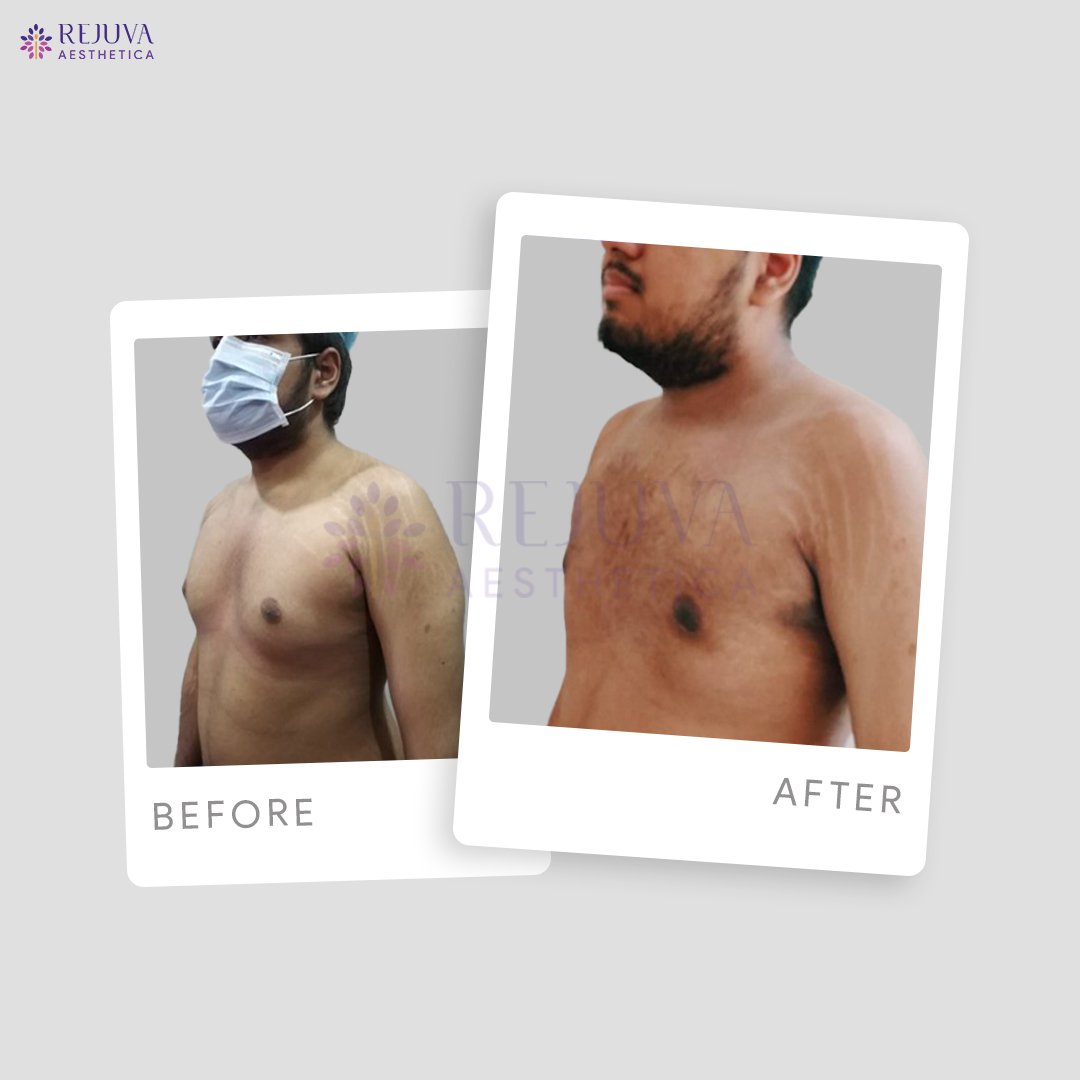
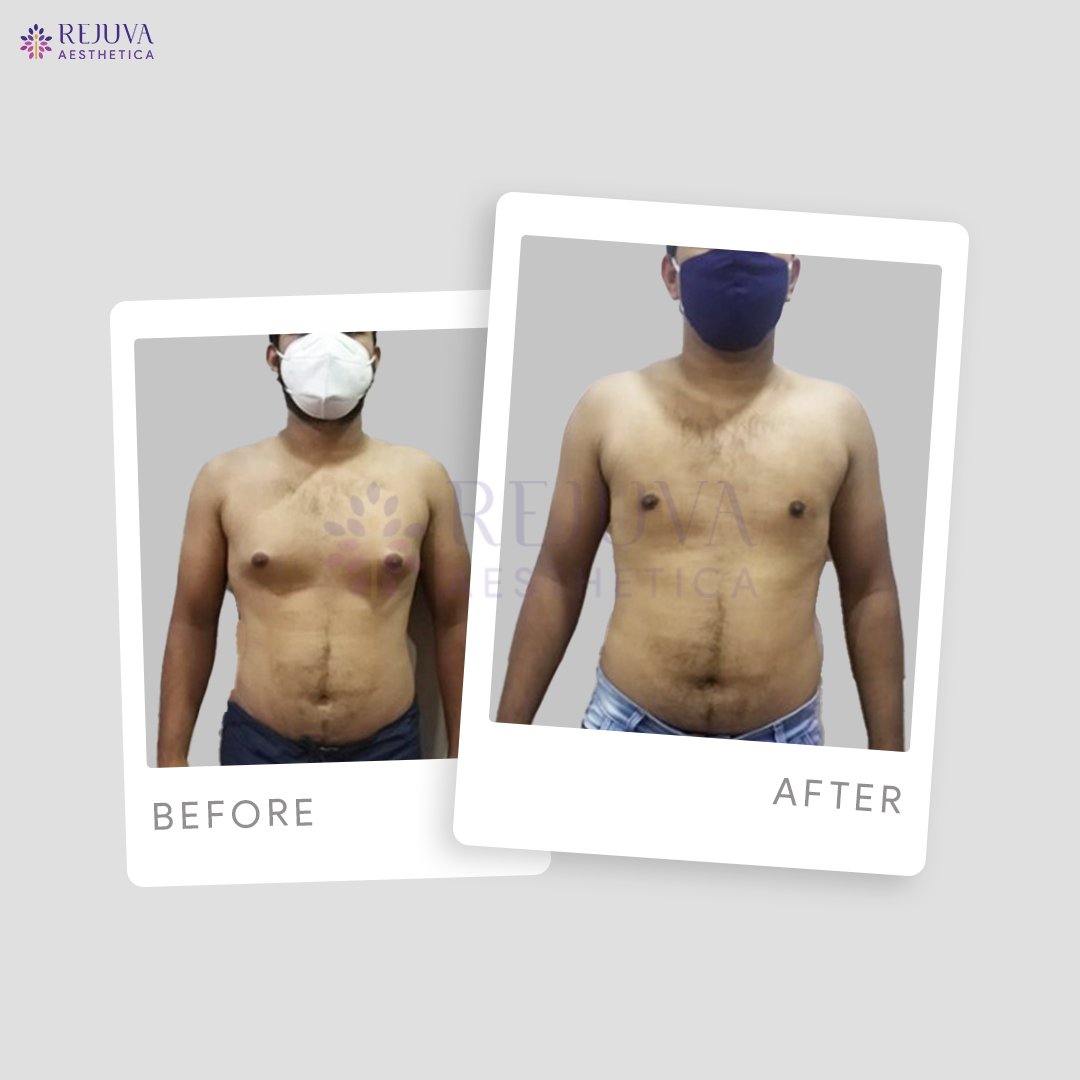
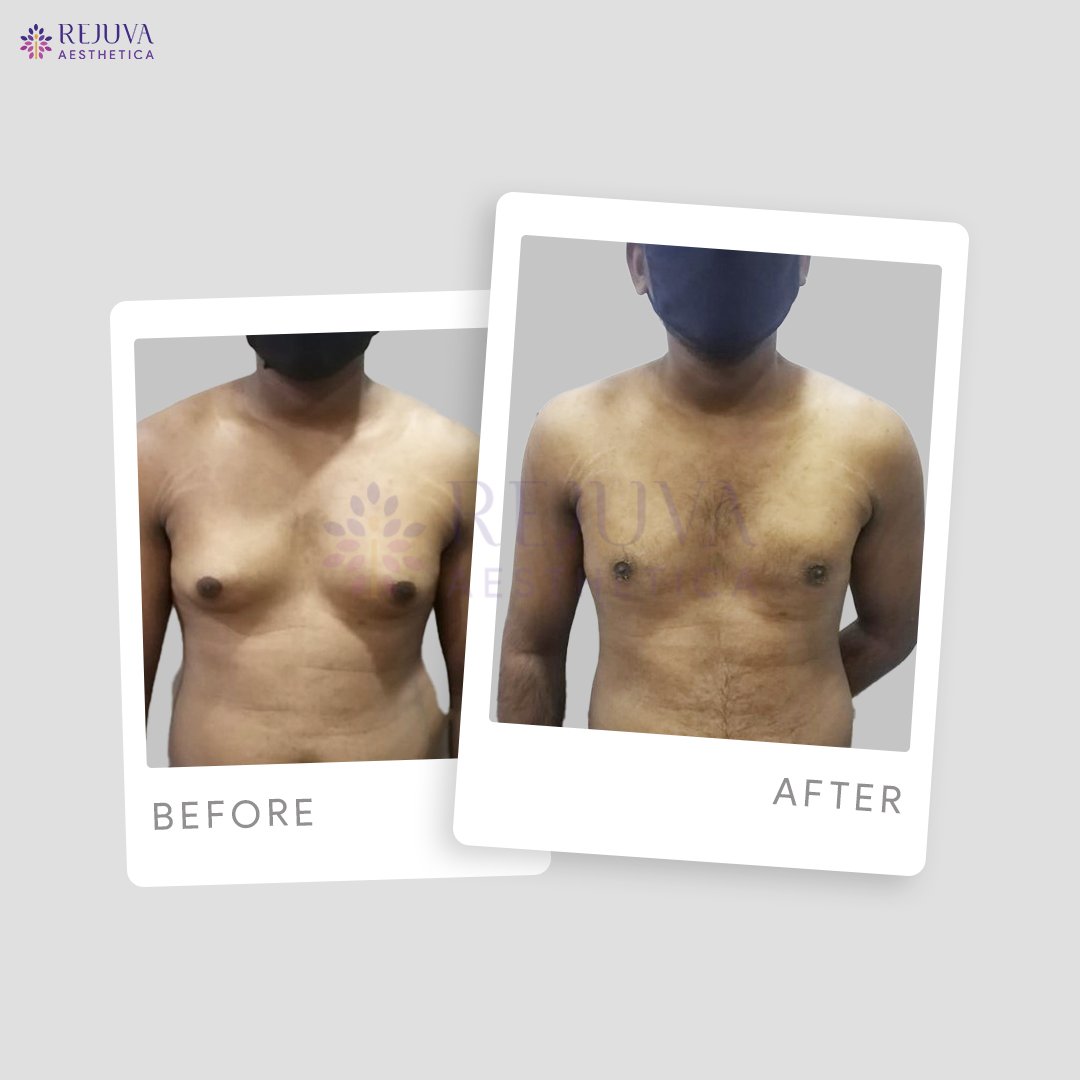
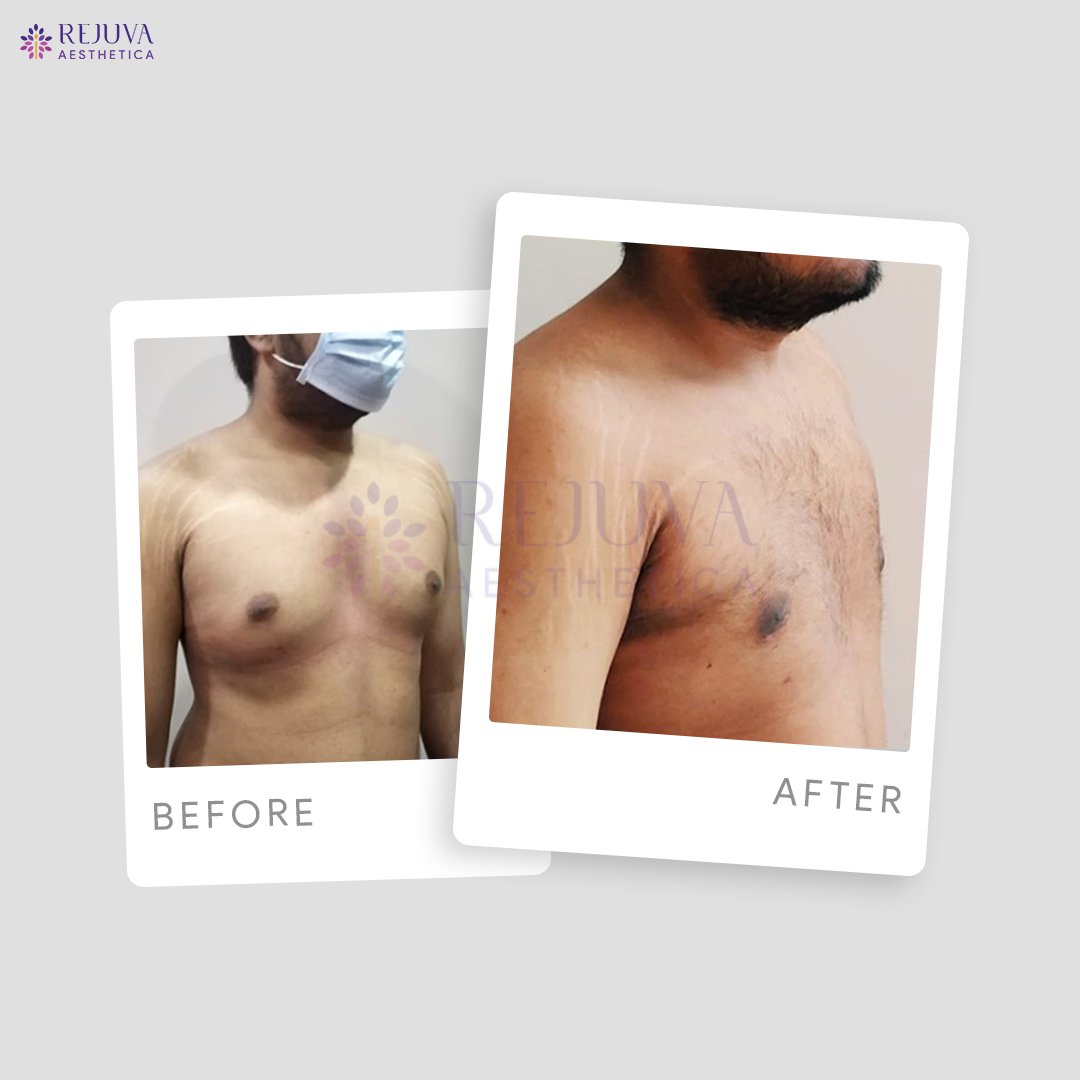
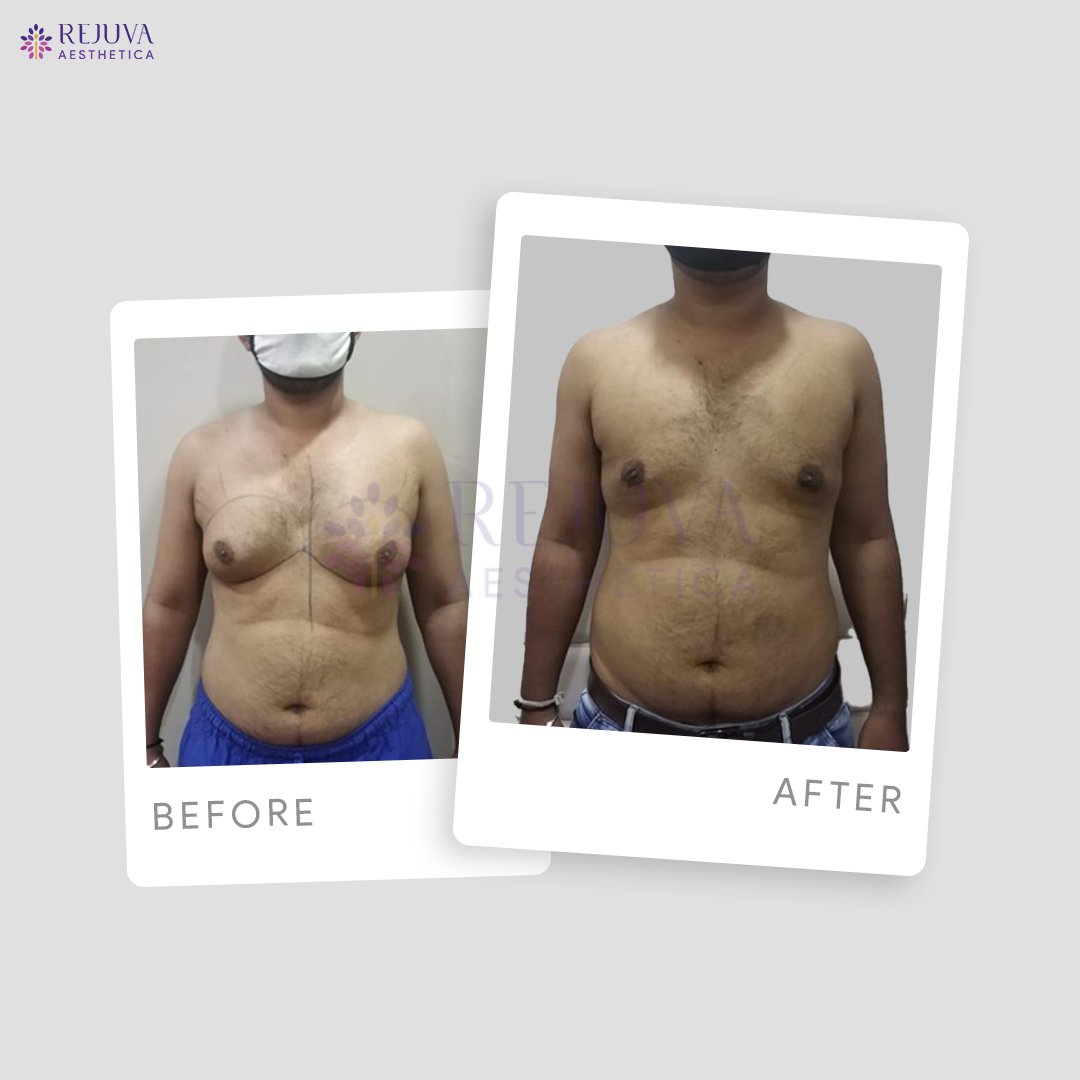
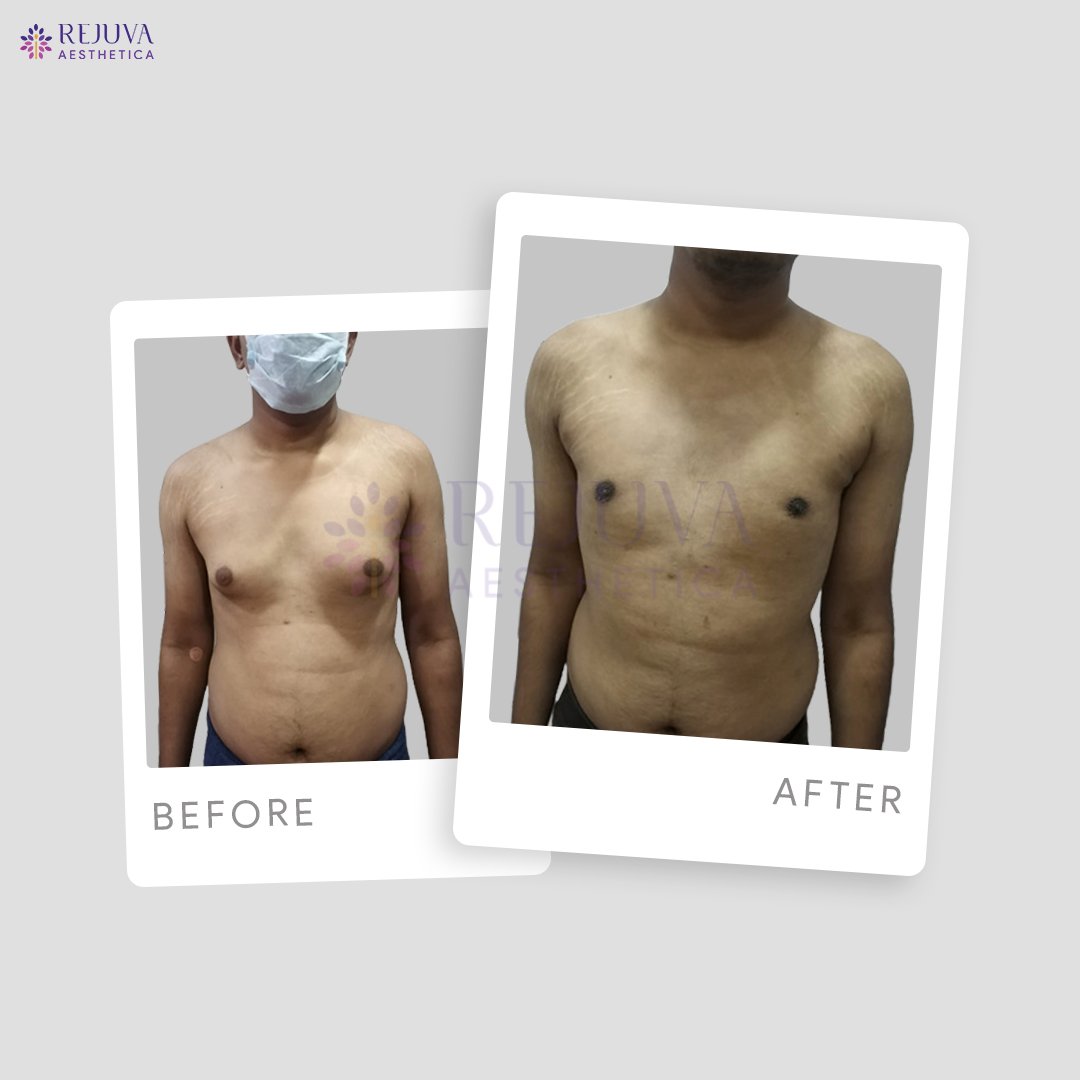
Before and After Treatment
Frequently Asked Question
Not if it is glandular. Training and dieting will reduce the fat around the gland, which can actually make the firm disc under the nipple more noticeable. Fat responds to a calorie deficit; breast gland does not. If your chest has softened everywhere else but a firm lump remains behind the nipple, that lump is gland and it needs to be removed surgically.
Lie on your back and bring your thumb and index finger together across the nipple. A distinct firm edge or disc that stops your fingers is glandular tissue. Tissue that compresses smoothly all the way is more likely fat. Gland is also often tender, particularly when it first appears. A clinical examination, with an ultrasound if the picture is unclear, gives you the definitive answer.
Most surgeons operate from 18 onwards. Adolescent gynecomastia frequently resolves on its own within 12 to 24 months, so operating too early risks doing surgery that was never needed. Younger patients are considered where the condition has been stable for well over a year and is causing significant distress - with parental involvement and after the same investigations any adult would have.
You feel nothing during the procedure. Afterwards most men describe tightness and soreness rather than sharp pain, comparable to a heavy chest workout, and it is managed with simple oral painkillers. The first 48 hours are the most uncomfortable. Very few patients need anything stronger than what is prescribed at discharge.
60 to 90 minutes for a standard Grade 1 or Grade 2 case. Grade 3 cases involving skin excision take two to three hours. You are at the clinic for roughly four to five hours in total including preparation and recovery.
No. This is a day-care procedure. You arrive in the morning, and for standard cases you go home the same evening once you are eating, walking and comfortable. You will need someone to drive you.
Three to five days for a desk job, and many men work from home from day two. If your work involves physical labour or lifting, plan on two to three weeks and clear it at your follow-up.
Light cardio at two to three weeks. Full chest and shoulder training at six weeks, on clearance. Going back early risks bleeding, fluid collection and a worse contour, and it will not speed anything up.
For Grade 1 and Grade 2 cases the incision sits at the lower border of the areola, where the colour change hides it, plus 3 to 4 mm liposuction ports placed at the side of the chest. Most are difficult to find after six to twelve months. Grade 3 cases need a longer scar, and that is discussed and drawn out for you before you consent.
Removed gland does not regrow. What can change the result is significant weight gain, a return to anabolic steroids or prohormones, or a new hormonal cause. Recurrence is uncommon after adequate excision, but it is not impossible, and any clinic promising zero recurrence is overstating it.
Typically Rs 50,000 to Rs 1,00,000 for Grade 1 to Grade 2, with Grade 3 and revision cases costing more. Your grade is the largest single variable. A full breakdown is on our gynecomastia surgery cost page.
Four things usually explain it: whether an MCh-qualified plastic surgeon is operating, whether it is an accredited operating theatre or a procedure room, whether the quote covers gland excision or only liposuction, and whether garments and follow-ups are included or billed later. A very low quote frequently turns out to be liposuction alone, which leaves the gland behind.
Usually not - most Indian insurers classify it as cosmetic and exclude it. Cover is occasionally granted where the condition is documented as symptomatic or has a diagnosed pathological cause, subject to pre-authorisation. We provide the clinical documentation; the decision rests with your insurer.
If your chest is predominantly soft fat and your BMI is high, yes - losing weight first gives a better, cheaper and more stable result. If the problem is a glandular disc, weight loss will not remove it and there is no reason to wait. The examination tells us which situation you are in.
Small Grade 1 cases can be done under local anaesthesia with sedation. Anything more extensive is more comfortable and safer under general anaesthesia. Both are day-care and the choice is made with the anaesthetist based on the extent of surgery and your health.
Routine pre-operative blood work - complete blood count, blood sugar, coagulation profile, viral markers - plus an ECG where age or history warrants it. A chest ultrasound if the lump is atypical, and a hormone panel if the history suggests an endocrine cause.
Technically yes, and gynecomastia is often worse on one side. In practice both sides are usually addressed, because matching a treated chest to an untreated one is difficult and asymmetry is the most common cosmetic complaint after this operation.
It changes the conversation, not the operation. Gland formed on cycle does not disappear when you stop, so surgery still removes it. But if you resume the same compounds without aromatase management, new gland can form in residual tissue. We will ask, and an honest answer produces a better plan.
Often, yes. The usual problems are residual gland, a crater or saucer deformity under the nipple, a nipple stuck down to the muscle, or contour ridges. Revision surgery is harder than the original operation and generally waits at least six months from the first procedure so the tissues settle. Bring your operative notes if you have them.
Yes. Patients travel to the clinic from across Gujarat and from other states. If you are travelling, plan to stay in Ahmedabad for days after surgery so the first dressing check and review can be done in person, after which follow-up can continue remotely with photographs.
Most commonly: a firm lump still present because the gland was never removed, a dish-shaped depression under the nipple from taking too much, a nipple that pulls inwards when you flex, visible ridges from uneven liposuction, or noticeable asymmetry. Knowing what these look like is the most useful thing you can take into a consultation, wherever you have it.
The chest is flatter immediately but swollen. Roughly 70 to 80 percent of the result shows at six to eight weeks, the contour is essentially final at three months, and scars finish maturing between six and twelve months.
Start Today
Ready to Get Started?
Book a complimentary consultation to discuss your goals and receive a personalised treatment plan.