
FUT Hair Transplant in Ahmedabad, Gujarat
Written and medically reviewed by Dr Arth Shah, MBBS (Gujarat University, 2009), MS General Surgery (Sardar Patel University, 2014), MCh Plastic & Reconstructive Surgery (B.J. Medical College, Ahmedabad, 2017). Gujarat Medical Council registration G-25994. Practising in Ahmedabad since 2018.
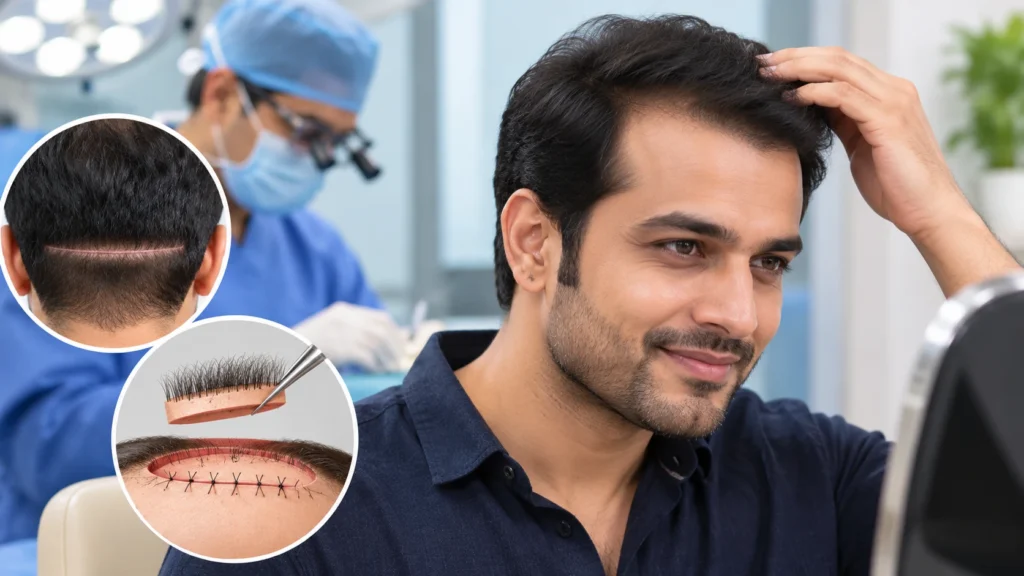
FUT – the strip technique – removes a narrow band of scalp from the back of your head, dissects it under a microscope into individual follicular units, and transplants them. It gives more grafts in one sitting than FUE, costs less per graft, and does not thin your donor area. The trade is a permanent linear scar, which is why it suits people who wear their hair at grade 4 or longer and does not suit people who shave. Cost in Ahmedabad works out around Rs 25 to Rs 50 per graft. Most patients today have FUE instead – and if that is you, the honest answer is on our FUE page.
Most hair transplant pages want you to have the procedure they are describing. This one starts differently, because FUT is not the right operation for most people who land on it. Around three quarters of hair transplants worldwide are now done by FUE, and that shift is not marketing – it happened because FUE avoids a linear scar and most patients want to keep the option of short hair. If that describes you, stop reading and go to the FUE page. You will get a better answer there and you will not have wasted an afternoon. FUT is still the better operation for a specific group. If you need a very large number of grafts in one sitting. If you wear your hair long and always will. If your donor density is limited and you want to protect it. If you are likely to need more work in fifteen or twenty years and want to preserve what you have. In those situations FUT does things FUE cannot, and the surgeons who abandoned it entirely gave up something useful. So this page covers the scar first – because that is the decision – then what FUT does better, who it suits, what it costs in Ahmedabad, and how it compares to FUE without either technique being sold as universally superior.
Should you be reading this page at all?
FUT suits you if you need a large number of grafts in one session, you wear your hair at grade 4 or longer and intend to keep doing so, your donor density is limited, or you expect to need further procedures over the coming decades. It does not suit you if you shave your head, wear a grade 1 or 2, or want the option of going short. For most patients today, FUE is the better answer.
|
If this is you |
The technique that fits |
|
You shave your head or wear grade 0-2 |
FUE – see FUE hair transplant |
|
You want the option of short hair one day |
FUE – see FUE hair transplant |
|
You need 3,000+ grafts in one sitting |
FUT – the strip yields more per session |
|
You wear your hair long and always have |
FUT is worth considering seriously |
|
Your donor density is limited |
FUT preserves it – see the donor section |
|
You are under 35 with progressive loss and will need more work later |
FUT first, FUE later, is a legitimate long-term plan |
|
You are cost-sensitive at a high graft count |
FUT is meaningfully cheaper per graft |
|
You have had FUE before and the donor is thinning |
FUT may still be available where further FUE is not |
|
You have a very tight scalp |
Possibly neither – see the scalp laxity section |
The scar - and the technique that changes it
FUT leaves a single thin horizontal scar across the back of the head, running roughly ear to ear or a shorter span depending on how many grafts are needed. Well executed on a patient with reasonable scalp laxity, it is typically one to two millimetres wide and covered completely by hair worn at grade 4 or longer. Closed under tension, or in a patient who scars poorly, it can be considerably wider. This is the decision the whole page turns on and it is permanent. Being straight about it: you will have a line. It will not disappear. What varies is how wide it is and whether anything grows through it – and the second of those is where technique matters more than most patients realise.
Trichophytic closure
This is the technique that separates a modern FUT scar from the ones people saw twenty years ago, and almost no clinic page in India explains it. When the strip is closed, the upper wound edge is trimmed at a shallow angle so that the hair follicles sitting right at the margin are left in place, partly transected. As the wound heals, those follicles grow up and through the scar line rather than stopping at either side of it. The result is a scar with hair growing out of it, which is dramatically harder to see than a bare line of the same width. It does not make the scar disappear and it is not guaranteed to work in every patient – some hair at the trimmed edge does not survive. But it is the difference between a scar you have to look for and one that is visible when the hair is wet or parted. If you are comparing surgeons for FUT, asking whether they use trichophytic closure is a genuinely useful question, and one very few patients know to ask.
What makes a FUT scar wider or narrower
|
Factor |
Effect |
|
Scalp laxity |
The single biggest factor. A loose scalp closes with almost no tension and heals to a fine line. A tight scalp means tension, and tension stretches a scar. |
|
Strip width |
A narrower strip closes more easily. A wide strip taken to hit a high graft number is the commonest cause of a stretched scar. |
|
Closure technique |
Layered closure that takes the tension in the deep tissue rather than the skin, plus trichophytic trimming of the upper edge. |
|
Your own healing |
Some people simply make wider scars. Previous surgical scars elsewhere on your body are the best guide, and worth mentioning at the consultation. |
|
Number of previous strips |
Each strip uses up laxity. The second is tighter than the first. |
|
Post-operative care |
Heavy neck movement, stretching, or gym work in the first weeks pulls on a healing closure. |
What FUT actually is
A narrow strip of hair-bearing scalp is removed from the safe donor zone at the back of the head, under local anaesthetic. The wound is closed. The strip is then taken to a bench where it is dissected under high-magnification microscopes into individual follicular units – the natural clusters of one to four hairs in which scalp hair grows. Those grafts are placed into tiny incisions made in the thinning area, exactly as in FUE.
The only real difference between FUT and FUE is how the grafts are obtained. Everything after harvesting – graft handling, site creation, angle, direction, density, placement – is identical, and it is that second half that determines whether the result looks natural. A poorly designed hairline looks equally transplanted whichever way the grafts were harvested.
One technical point in FUT’s favour: because the strip is dissected under a microscope with the follicle visible, transection rates can be very low. FUE extraction is done blind – the punch goes through skin and the surgeon cannot see the angle of the follicle beneath it – which is why FUE transection depends heavily on operator skill. This is a real advantage and it is worth understanding rather than taking either technique on faith.
Benefits of FUT
More grafts in a single session than FUE, a lower cost per graft, no thinning of the surrounding donor area, microscopic dissection with the follicle visible, no need to shave the whole donor region, and the ability to repeat the procedure with each strip removing the previous scar. Against all of that sits one permanent linear scar.
- Higher yield per session. A strip can produce very large graft numbers in one sitting. See the mega-session section below.
- Lower cost per graft, by a meaningful margin. Section on cost below.
- The donor area is not thinned. The most under-appreciated advantage and it has its own section.
- Grafts are dissected under magnification with the follicle visible, rather than extracted blind.
- No full donor shave. Only the strip area is trimmed, so the change is far less obvious to anyone who sees you before the procedure.
- It can be repeated, with each new strip excising the previous scar – so multiple FUT procedures still leave one scar, not several.
- Shorter time in the chair for a given graft count than FUE, because harvesting is a single excision rather than thousands of individual extractions.
The donor density argument nobody explains
Most patients assume FUE is the more conservative choice because the scars are smaller. For your lifetime donor supply, the opposite can be true. FUE takes follicular units from across the whole donor area. Every unit removed is permanently gone from where it was, and the density of the entire donor drops a little. Do that three times over twenty years and the donor becomes visibly thinner overall – which is a problem, because the donor is what makes any future procedure possible.
FUT takes a defined band and closes it. Everything above and below that band keeps its original density. A second strip excises the first scar rather than adding a new one. So after two FUT procedures you have one scar and a donor that is still at full density outside it.
This matters most for the patient it is least often explained to: someone in their late twenties or early thirties with progressive loss, who is almost certain to need further work at 40 and possibly again at 55. For that person, a strip-first strategy can leave more usable donor across a lifetime than starting with FUE. It is not a universal rule and it depends on donor characteristics – but it is a real consideration and it is worth having at the consultation rather than discovering at 45.
Mega hair restoration surgery in Ahmedabad
A mega-session is a single sitting of roughly 3,000 grafts or more – some clinics use the term above 2,500 and call anything over 4,000 or 5,000 a giga-session. FUT is the technique best suited to it, because one strip can yield those numbers in a single harvest rather than requiring thousands of individual extractions. For a patient with advanced pattern baldness who wants maximum coverage in one procedure, this is the clearest clinical case for choosing FUT.
What a mega-session is
Practically, it means a long day – eight to twelve hours – a larger strip, a bigger dissection team working through it, and a great many recipient sites. The advantage is that a Norwood 5 or 6 pattern can be substantially addressed in one procedure rather than two spaced a year apart, which matters if you are travelling for surgery or cannot take time off twice.
When a bigger session is not the better plan
Two honest caveats, and they are the reason this section reads differently from most mega-session marketing.
- Longer is not automatically better. A very long procedure means a large cumulative volume of local anaesthetic, grafts held outside the body for longer, and a tired team by hour ten. All three are manageable with proper planning and a team sized for the job – and all three are real. The question is not whether a clinic can quote a big number; it is whether they can place that many grafts efficiently enough that the last thousand survive as well as the first.
- A bigger session uses more of a finite resource. Your donor supply is limited and permanent. Spending a large share of it in one sitting at 30 can leave too little for the areas that will be bald at 45 – and the crown, in particular, keeps expanding. A surgeon who recommends fewer grafts than you were quoted elsewhere may be planning for your forties rather than under-treating you.
So the useful version of this conversation is not “how many grafts can I get” but “how many should I use now, and what am I keeping back”. That is what the consultation should establish.
Areas we transplant
The same areas as FUE – hairline, mid-scalp and crown, plus beard, moustache and eyebrows, and camouflage of scars. What differs with FUT is the donor: grafts come from a strip taken across the occipital safe zone rather than from across the whole back and sides.
- The highest-impact area per graft and the most technically demanding, because angle, direction and irregularity of the front row decide whether the result looks natural. Microscopically dissected single-hair grafts from a strip are well suited to it.
- Mid-scalp. The most forgiving zone, and where the bulk of grafts usually go in a large session.
- The most graft-hungry area because hair grows in a whorl over a curved surface. It is also the area that keeps expanding, which is why it is often deliberately left for later.
- Beard, moustache and eyebrows – see beard and moustache transplant. Note that for small facial areas FUE is usually the better harvest, so this is more often a cross-reference than a FUT indication.
- Scar camouflage, including old FUT scars and the results of previous poorly executed work.
Conditions we treat - and who FUT does not suit
FUT treats androgenetic alopecia – male and female pattern hair loss – in patients with a stable, adequate donor area and enough scalp laxity for a strip to be closed without tension. It is not suitable for diffuse unpatterned thinning, active inflammatory hair loss, a tight scalp, or anyone who wants to keep the option of very short hair.
Who it suits
- Advanced pattern baldness needing a large number of grafts.
- Patients who wear their hair at grade 4 or longer and intend to keep doing so.
- Patients with limited donor density where preserving it matters.
- Patients likely to need repeat procedures across decades.
- Patients who have already had significant FUE and whose donor is thinning.
Who it does not
- Anyone who shaves or wears grade 0-2. The scar will show. Send them to FUE.
- Tight scalp. See below.
- Diffuse unpatterned thinning, where the donor is thinning too – moving hair from it relocates the problem.
- Active alopecia areata or scarring alopecia, which need medical management first.
- A keloid tendency or a history of hypertrophic scarring. A linear scar in a keloid-prone patient is a poor bet.
- Very young patients with rapid loss and no medical treatment started – the same caution as on the FUE page.
Scalp laxity: the constraint that decides it
FUT is only possible if your scalp is loose enough for a strip to be removed and the edges brought together without excessive tension. This is assessed by hand at the consultation – the surgeon moves the scalp on the skull and estimates how much can be taken. A tight scalp means a narrower strip and fewer grafts, or a closure under tension and a wider scar.
It also caps how many times FUT can be repeated. Each strip uses some laxity, so the second is tighter than the first and there is a practical limit. Being told “your scalp is too tight for the strip you would need” is a real and reasonable consultation outcome, and no page in this market prepares patients for it.
Scalp exercises to increase laxity before surgery are sometimes recommended. The evidence is limited and it is worth asking rather than assuming.
How many grafts, and how many times
The graft number comes from your Norwood stage and your donor, not from a price list. As a guide: Norwood 3 needs roughly 1,500 to 2,500 grafts, Norwood 4 about 2,500 to 3,500, Norwood 5 about 3,000 to 4,500, and Norwood 6 to 7 typically over 4,000 and often staged. What FUT adds to that conversation is how much you should use now versus keep for later.
|
Norwood stage |
Typical graft range |
FUT-specific note |
|
Stage 3 |
1,500 – 2,500 |
Achievable with a modest strip. FUE is also very reasonable here. |
|
Stage 3 vertex |
2,000 – 3,000 |
Consider whether the crown is worth treating now. |
|
Stage 4 |
2,500 – 3,500 |
A good FUT indication if hair is worn long. |
|
Stage 5 |
3,000 – 4,500 |
Mega-session territory. Strip yield is a genuine advantage. |
|
Stage 6-7 |
4,000+, often staged |
Donor supply is the limit, not technique. Expect a plan across two procedures. |
Who performs your surgery
In a large share of hair transplants in India, most of the practical work is carried out by technicians with the doctor designing the hairline and supervising. Published commentary on Indian pricing puts technician-led clinics at roughly Rs 15 to Rs 25 per graft against surgeon-led at Rs 40 to Rs 100. That gap is not mainly about equipment.
FUT has one part that is unambiguously surgical and cannot be delegated: the strip excision and closure. That is a surgical procedure on the scalp, and the quality of the closure is what determines the scar you live with for the rest of your life. Graft dissection and placement involve a trained team in every clinic – no surgeon dissects three thousand grafts alone – but the harvest and the closure are the surgeon’s work.
What can be said either way: Dr Arth Shah holds an MCh in Plastic and Reconstructive Surgery, the full superspecialty surgical qualification in India, and all surgical work at this clinic is performed by him. For FUT specifically, where the operation includes an excision and a layered closure, that qualification is directly relevant rather than a general credential.
The procedure, step by step
A FUT session runs six to ten hours for a standard case and up to twelve for a mega-session, under local anaesthetic, and you go home the same evening. You are awake throughout. The harvest itself takes under an hour; the rest of the day is dissection and placement.
Step 1 – Consultation and donor assessment
Examination of the thinning areas, Norwood staging, and – specific to FUT – an assessment of scalp laxity by hand. Donor density and hair calibre are measured. A discussion about how you wear your hair now and whether that is likely to change, because that is the question that decides FUT versus FUE.
Step 2 – Planning the strip and the design
How many grafts, therefore how wide and long the strip needs to be, therefore whether your laxity allows it. The hairline is drawn on you and agreed. You should leave knowing your graft number, where the strip is coming from, and roughly how long the scar will be.
Step 3 – Investigations
Routine blood count, blood sugar, coagulation profile and viral markers. Thyroid function and ferritin where diffuse thinning is in the picture.
Step 4 – Preparation
- Stop blood thinners, aspirin and most supplements as instructed.
- No alcohol for a few days before.
- Stop smoking for at least two weeks before and after – it affects both graft survival and wound healing at the closure.
- Wash your hair the morning of surgery. Eat normally.
- Bring a button-up shirt.
Step 5 – Trimming and marking
Only the strip area is trimmed – a band a couple of centimetres tall across the back of the head, which the hair above it covers immediately. This is one of FUT’s practical advantages: you are not walking out with a shaved head. The strip dimensions and the hairline are marked and confirmed with you.
Step 6 – Local anaesthetic
Infiltrated into the donor area, then into the recipient area later. The injections are the uncomfortable part and they take a few minutes. After that you feel pressure but not pain.
Step 7 – Strip harvest and closure
The strip is excised at a depth that follows the angle of the follicles, so units at the edges are not cut across. The wound is then closed – deep layer first so the tension is taken below the skin, then the skin itself, with the upper edge trichophytically trimmed so hair can grow through the line. Stitches or staples; both are used and both work. This is the surgical part of the day and it takes well under an hour.
Step 8 – Microscopic dissection
The strip goes to a bench where it is cut under high-magnification microscopes into individual follicular units, sorted by hair count, and held in chilled storage solution. This is the longest phase and it runs in parallel with site creation.
Step 9 – Recipient site creation
Tiny incisions at the correct angle, direction and depth. This is the step that decides whether the result looks natural, more than any other, and it is identical in FUT and FUE.
Step 10 – Placement
Single-hair units along the front row for a soft irregular hairline, multi-hair units behind for density. Grafts spend as little time as possible outside the body.
Step 11 – Dressing and discharge
The donor line is dressed; the recipient area is usually left open. You are shown how to wash, how to sleep, and what to avoid. Stitches or staples come out at 10 to 14 days.
Recovery and downtime
Most people are back at desk work in three to five days – slightly longer than FUE, because the donor area is tight and sore for the first week. The recipient area is red and crusted for seven to ten days. Stitches or staples come out at 10 to 14 days. No gym, heavy lifting or neck stretching for three to four weeks, because pulling on a healing closure is what widens a scar.
|
When |
What to expect |
What you can do |
|
Day 0 |
Tightness across the back of the head as the anaesthetic wears off. This is the part that differs from FUE. |
Home the same evening. Sleep propped up at 45 degrees. |
|
Day 1-3 |
Donor area sore and tight. Redness and small crusts across the recipient area. Forehead swelling common. |
First wash as instructed. Painkillers as needed – most people need them for two to three days. |
|
Day 3-5 |
Tightness easing. Crusts still present. |
Back to desk work for most people. |
|
Day 7-10 |
Crusts loosening. Donor line settling. |
Do not pick. Still no gym or stretching. |
|
Day 10-14 |
Stitches or staples removed. |
Normal washing. Light activity. |
|
Week 3-4 |
Transplanted hair begins to shed. Normal – see the results section. |
Gym and normal exercise from three to four weeks on clearance. Avoid heavy neck work a little longer. |
|
Month 2-3 |
Nothing visible growing. Donor line maturing from red to pale. |
Normal life. The psychologically hardest phase. |
|
Month 4-6 |
New growth begins. |
Haircuts as usual – keep it at grade 4 or longer while the donor line is still pink. |
|
Month 12-18 |
Final result. Donor scar at its final appearance. |
– |
Call the clinic if
- Increasing pain, spreading redness or discharge from the donor line after day three rather than settling.
- The donor closure appears to be separating.
- Bleeding that does not stop with gentle pressure.
- Persistent numbness or shooting pain along the donor line beyond a few weeks.
FUT hair transplant cost in Ahmedabad, Gujarat
FUT in Ahmedabad works out around Rs 25 to Rs 50 per graft at established clinics – meaningfully less than FUE, which typically runs Rs 35 to Rs 70. So a 3,000-graft FUT session is roughly Rs 75,000 to Rs 1,50,000 against Rs 1,05,000 to Rs 2,10,000 for the same number by FUE. Check whether GST at 18 percent is included in any quote; it frequently is not.
|
Session |
Typical FUT range in Ahmedabad |
Same by FUE, for comparison |
|
1,500 grafts |
Rs 40,000 – 75,000 |
Rs 50,000 – 1,05,000 |
|
2,000 grafts |
Rs 50,000 – 1,00,000 |
Rs 70,000 – 1,40,000 |
|
2,500 grafts |
Rs 62,000 – 1,25,000 |
Rs 87,000 – 1,75,000 |
|
3,000 grafts |
Rs 75,000 – 1,50,000 |
Rs 1,05,000 – 2,10,000 |
|
4,000+ grafts (mega-session) |
Rs 1,00,000 – 2,00,000 |
Often staged rather than single-session |
|
Repeat FUT (second strip) |
Contact our clinic |
Not directly comparable |
|
FUT scar revision |
Contact our clinic |
– |
Full cost comparison across techniques is on our hair transplant cost in Ahmedabad page.
What the price includes, and what it does not
|
Included |
Charged separately |
|
Surgeon’s fee, strip harvest and closure |
Consultation |
|
Local anaesthetic and all consumables |
Pre-operative blood work |
|
Microscopic dissection, sorting and counting |
GST at 18% |
|
Recipient site creation and graft placement |
Finasteride, minoxidil or other ongoing treatment |
|
Suture or staple removal at 10-14 days |
PRP sessions, if recommended |
|
Post-operative medication for the first couple of days |
A second procedure, where the plan is staged |
|
Scheduled follow-ups at intervals |
Scar revision, if ever needed |
Why FUT costs less than FUE
It is not a quality difference and it is worth saying so. Harvesting a strip takes under an hour; extracting three thousand grafts individually takes several. The dissection is done by a bench team working in parallel with site creation, which uses time efficiently. FUE ties up the surgeon for the entire extraction phase. That labour difference is most of the price gap.
Results timeline - including the shedding phase
At two to four weeks the transplanted hair falls out. This is expected and it happens to nearly everyone. The follicle stays in place; the hair shaft it was carrying sheds while the follicle resets into a resting phase. Growth restarts at three to four months. If nobody warns you, week three is genuinely alarming – people believe the surgery has failed before anything has had a chance to happen.
|
When |
What is happening |
|
Week 1-2 |
Redness and crusting settle. Donor line tight, then easing. Sutures out at 10-14 days. |
|
Week 2-4 |
Shedding. Most transplanted hairs fall out. Normal and expected. |
|
Month 1-3 |
Nothing visible growing. Some patients also shed a little native hair – shock loss – which recovers. Donor line fading from red to pale. |
|
Month 3-4 |
First new growth appears – fine, soft hairs. |
|
Month 5-6 |
Growth becomes obvious. Roughly 40-50% of the final result. |
|
Month 7-9 |
Hair thickens and takes on normal texture. Around 70-80%. |
|
Month 10-12 |
Close to final for the hairline and mid-scalp. |
|
Month 12-18 |
Crown finishes last. Donor scar reaches its final appearance – this is when to judge both. |
Two honest points. Not every graft grows; realistic survival in competent hands is in the region of 85 to 95 percent, not 100. And the donor scar takes as long to mature as the transplanted hair takes to grow – a scar that looks pink and obvious at month three usually looks quite different at month twelve.
Before-and-after photographs are in the before-and-after results gallery. Ask what interval each was taken at, and for FUT specifically ask to see donor photographs as well as recipient ones – a gallery that only shows the front is not showing you the thing you are worried about.
FUT vs FUE: the honest comparison
Neither technique is better. They harvest grafts differently and everything after that is identical. FUE avoids a linear scar and suits anyone who might wear their hair short, which is why it is now the large majority of procedures worldwide. FUT gives more grafts per session, costs less per graft, and preserves donor density, which is why it remains the better choice for a specific group.
|
|
FUT (strip) |
FUE |
|
How grafts are obtained |
A strip is excised and dissected under microscopes |
Units extracted individually with a punch |
|
Scar |
One linear scar, typically 1-2 mm wide if well closed |
Hundreds to thousands of tiny round scars |
|
Short hair |
Covered at grade 4 and longer; visible shorter |
Fine at grade 2 and above; dots may show at grade 0-1 |
|
Donor density afterwards |
Unchanged outside the strip |
Reduced across the whole donor area, permanently |
|
Grafts per session |
Higher – suits mega-sessions |
Typically up to about 3,000-3,500 |
|
Repeat procedures |
Each strip excises the previous scar. Limited by scalp laxity |
Progressively depletes the whole donor |
|
Graft transection |
Low – dissection is done under magnification with the follicle visible |
Depends heavily on operator skill; extraction is blind |
|
Donor shave |
Only the strip band is trimmed |
Usually the whole donor is shaved |
|
Recovery |
Slightly longer – tightness, sutures out at 10-14 days |
No stitches, faster |
|
Cost per graft |
Lower – roughly Rs 25-50 |
Higher – roughly Rs 35-70 |
|
Procedure length |
Shorter for a given graft count |
Longer – individual extraction |
|
Best for |
Large sessions, long hair, limited donor, planning for repeat work |
Most patients, especially anyone who might go short |
Which one suits you
The single question that decides it: how short do you wear your hair, and might that change? If the answer is grade 4 and longer, always, then FUT’s disadvantage costs you nothing and its advantages are real. If there is any chance you will want a grade 2 or want to shave it in ten years, take FUE and accept the higher price.
Everything you need on the alternative is on our FUE hair transplant page, including what FUE donor scarring actually looks like – which is not “scarless”, whatever you have been told elsewhere.
A transplant does not stop hair loss
This applies identically to FUT and FUE and it is the most important thing on either page. A transplant moves hair that is genetically resistant to pattern baldness. It does nothing to the native hair around it, which carries on thinning. Without medical treatment of that ongoing loss you can end up with a transplanted hairline in front of a thinning scalp – which sometimes looks worse than where you started.
This is the commonest reason people need a second procedure sooner than expected, and the commonest reason a technically good transplant disappoints at five years.
- Finasteride reduces the hormone driving pattern baldness and is the most effective medical treatment available for men. It has recognised side effects in a minority, which should be discussed properly, and it is a long-term commitment.
- Minoxidil prolongs the growth phase, is usable by men and women, and requires continuous use.
- PRP and similar injectables as adjuncts – see PRP therapy.
A clinic that sells you a transplant and never raises medical treatment is selling you half the plan.
Risks and what can go wrong
The recognised risks are a wider scar than intended, poor graft survival, an unnatural hairline from poor design or angle, temporary or occasionally lasting numbness along the donor line, shock loss of native hair, folliculitis, infection, and rarely wound separation at the closure. Most are technique-dependent rather than bad luck, which is why the closure and the design matter more than the equipment.
The ones specific to FUT
- A stretched scar. The main FUT-specific risk. Caused by a strip too wide for the available laxity, a closure under tension, heavy activity too early, or a patient who simply scars widely. It is why laxity assessment and closure technique matter more here than anything else.
- Numbness along and above the donor line. Small sensory nerves are divided by the excision. Numbness for several weeks is normal; a narrow band of lasting reduced sensation above the scar is not unusual and is generally a nuisance rather than a problem.
- Wound separation, rare, and almost always associated with tension or with smoking.
- Persistent tightness for several weeks, which is normal and settles.
And the ones shared with FUE
- An unnatural hairline – a design failure rather than a complication, and difficult and expensive to correct.
- Poor graft survival from rough handling, long time out of the body or crushed placement. You will not know for a year.
- Shock loss of native hair around the grafts, which usually recovers.
- Anaesthetic considerations – a long session uses a substantial cumulative volume of local anaesthetic and must be dosed and monitored properly.
Scar revision, if you are unhappy with an old one
A wide or poorly placed FUT scar from a previous procedure can often be improved. Options are excision and re-closure with trichophytic technique, which trades a wide scar for a narrower one; FUE grafting of hair directly into the scar tissue, which camouflages it; or scalp micropigmentation over it. Sometimes a combination.
Grafting into scar tissue has lower survival than into normal scalp because the blood supply is poorer, so a second pass is sometimes needed – but the improvement is usually substantial. See also scalp micropigmentation.
How to choose a FUT hair transplant surgeon in Ahmedabad
For FUT specifically, three things matter more than anything else: who performs the strip excision and closure, whether trichophytic closure is used, and whether your scalp laxity was actually assessed by hand before a graft number was quoted. A clinic that gives you a graft figure over the phone has not assessed whether the strip is even possible.
Seven questions worth asking anywhere, including here
- What is your qualification and medical registration number? MCh or DNB in plastic surgery, or MD dermatology, are the relevant Indian qualifications.
- Who performs the strip excision and the closure? This is the surgical part and it determines your scar. Ask for the answer in those terms.
- Do you use trichophytic closure? If they do not know the term, that tells you something.
- How lax is my scalp, and how wide a strip does my graft number need? These two must be reconciled before any number is promised.
- Can I see donor photographs at twelve months, not just recipient photographs? The scar is what you are buying a risk on. Ask to see it.
- What do you recommend for the hair I am still losing?
- What is left for a second procedure, and would that be another strip or FUE?
Your doctor: Dr Arth Shah, MS, MCh (Plastic Surgery)
Skin treatments at Rejuva Aesthetica are overseen by Dr Arth Shah, who completed his MBBS at Gujarat University in 2009, his MS in General Surgery at Sardar Patel University, Vallabh Vidyanagar in 2014, and his MCh in Plastic and Reconstructive Surgery at B.J. Medical College, Ahmedabad in 2017. He is registered with the Gujarat Medical Council under registration number G-25994 and has practised in Ahmedabad since 2018.
Book a consultation in Ahmedabad
A consultation takes about 25 minutes. Your donor is assessed, your scalp laxity is checked by hand, your loss is staged, and you are told whether FUT or FUE is the better technique for you – which quite often is FUE. If FUT is right, you get a graft number, a strip plan, an indication of scar length and a written quote.
Rejuva Aesthetica – Plastic & Cosmetic Surgery Clinic 102, Himalaya Emerald, Besides IOC Petrol Pump, Near Shivranjani Over Bridge, Jodhpur, Ahmedabad, Gujarat 380015 Phone: +91 74360 00990 | 079 2692 9299 Monday to Saturday, 9:00 AM to 7:00 PM. Closed Sundays and public holidays. |
Frequently Asked Question
The question that decides it is how short you wear your hair and whether that might change. FUT leaves one linear scar covered at grade 4 and longer; FUE leaves thousands of tiny scars invisible at grade 2 and above. If you might ever want a grade 2 or a shaved head, take FUE. If you wear your hair long and always will, FUT gives you more grafts per session, a lower cost per graft, and preserves your donor density - all of which are real advantages.
A single horizontal line across the back of the head. Well executed on a patient with reasonable scalp laxity it is typically one to two millimetres wide and completely covered by hair worn at grade 4 or longer. Closed under tension, or in someone who scars poorly, it can be considerably wider. Strip width, scalp laxity, closure technique and your own healing all affect it.
A closure technique where the upper wound edge is trimmed at a shallow angle so hair follicles at the margin grow up through the scar line rather than beside it. The result is a scar with hair growing out of it, which is far harder to see than a bare line of the same width. It does not eliminate the scar and does not work perfectly in every patient, but it is the single biggest technical advance in modern FUT and it is worth asking any surgeon whether they use it.
Around Rs 25 to Rs 50 per graft at established clinics, so roughly Rs 75,000 to Rs 1,50,000 for a 3,000-graft session. That is meaningfully less than FUE, which typically runs Rs 35 to Rs 70 per graft. Check whether GST at 18 percent is included.
Labour, not quality. Harvesting a strip takes under an hour; extracting three thousand grafts individually takes several hours of the surgeon's time. Dissection is done by a bench team in parallel with site creation, which uses the day efficiently. That difference accounts for most of the price gap.
Less than FUE does, which surprises most people. FUT removes a defined band and closes it - everything above and below keeps its original density. FUE extracts units from across the whole donor, permanently reducing its density everywhere. For someone likely to need several procedures over decades, FUT can preserve more total donor supply across a lifetime.
Yes. Each new strip is planned to include the previous scar so it is excised rather than added to, which means two or three FUT procedures still leave a single scar. The limit is scalp laxity - each strip uses some, so there is a practical ceiling, and it is assessed by hand each time.
It is how loose your scalp is on the skull, assessed by hand at the consultation. FUT is only possible if the strip can be removed and the edges brought together without excessive tension. A tight scalp means a narrower strip and fewer grafts, or a closure under tension and a wider scar. Being told your scalp is too tight for the strip you would need is a real and reasonable outcome.
A single sitting of roughly 3,000 grafts or more; some clinics use the term above 2,500. FUT is well suited to it because one strip can yield those numbers in a single harvest. Two caveats worth knowing: a very long procedure means more anaesthetic and grafts held outside the body longer, and a large session uses a large share of a finite donor supply that you may need again in fifteen years.
The local anaesthetic injections at the start are uncomfortable and take a few minutes. After that you feel pressure but not pain. What differs from FUE is afterwards - the donor area is tight and sore for the first week because a strip has been removed and the edges closed. Most people need simple painkillers for two to three days.
Three to five days for desk work, slightly longer than FUE because of the donor tightness. The recipient area is red and crusted for seven to ten days. Sutures or staples come out at 10 to 14 days. No gym, heavy lifting or neck stretching for three to four weeks, because pulling on a healing closure is what widens a scar.
No - only a band across the strip area is trimmed, and the hair above it covers it immediately. This is one of FUT's practical advantages: you do not walk out with a shaved head, which matters if you do not want anyone to know.
Because that is what is supposed to happen. At two to four weeks most transplanted hairs shed while the follicle resets into a resting phase. The follicle stays in place. New growth starts at three to four months and the final result is at twelve to eighteen months.
No. A transplant moves hair that is resistant to pattern baldness; the native hair around it keeps thinning. Without medical treatment such as finasteride or minoxidil you can end up with a transplanted hairline in front of a thinning scalp. Surgery and medical management are one plan, not two options.
It depends on your Norwood stage and your donor. As a guide, Norwood 3 needs roughly 1,500 to 2,500 grafts, Norwood 4 about 2,500 to 3,500, Norwood 5 about 3,000 to 4,500, and Norwood 6 to 7 typically over 4,000 and often staged. With FUT there is a second constraint: whether your scalp laxity allows a strip wide enough to yield that number.
No, but it is no longer the default. Roughly three quarters of hair transplants worldwide are now FUE, and that shift happened because most patients want the option of short hair. FUT remains the better technique for large sessions, for patients who wear their hair long, and where preserving donor density matters. It is a technique with specific indications rather than an obsolete one.
Often, yes. Options are excision and re-closure using trichophytic technique to trade a wide scar for a narrower one, FUE grafting of hair directly into the scar to camouflage it, or scalp micropigmentation over it - sometimes a combination. Grafting into scar tissue has lower survival because the blood supply is poorer, so a second pass is sometimes needed.
Some, along and above the donor line, because small sensory nerves are divided by the excision. Numbness for several weeks is normal. A narrow band of lasting reduced sensation above the scar is not unusual and is generally a nuisance rather than a problem.
Yes, and it has a specific advantage for women: because only a strip band is trimmed rather than the whole donor being shaved, it is far easier to conceal. Female hair loss is usually diffuse rather than patterned, so the assessment is different and a treatable medical cause should be excluded first, but for suitable candidates FUT is often the more practical technique.
Six to ten hours for a standard session and up to twelve for a mega-session. The strip harvest itself takes under an hour; the rest is microscopic dissection and placement, which run in parallel.
Yes, and it is sometimes the best plan for a very large case - a strip for volume plus FUE from areas outside the strip zone, or beard hair as a supplementary donor. It maximises the grafts available in one sitting.
To keep the scar hidden, yes - grade 4 or longer is the usual threshold. If that is not a commitment you want to make, FUE is the right technique for you and this page has done its job by telling you so.
Three to four weeks, and be careful with anything involving neck movement or straining for a little longer. Pulling on a healing donor closure in the first weeks is one of the main causes of a stretched scar, and it is entirely avoidable.
Yes, from across Gujarat and other states. Most out-of-town patients arrive the day before, have the procedure, stay one night for the first wash and check, and travel home. Sutures can usually be removed locally at 10 to 14 days if returning is difficult.
Start Today
Ready to Get Started?
Book a complimentary consultation to discuss your goals and receive a personalised treatment plan.