Facial Scar Revision in Ahmedabad
Written and medically reviewed by Dr Arth Shah, MBBS (Gujarat University, 2009), MS General Surgery (Sardar Patel University, 2014), MCh Plastic & Reconstructive Surgery (B.J. Medical College, Ahmedabad, 2017). Gujarat Medical Council registration G-25994.
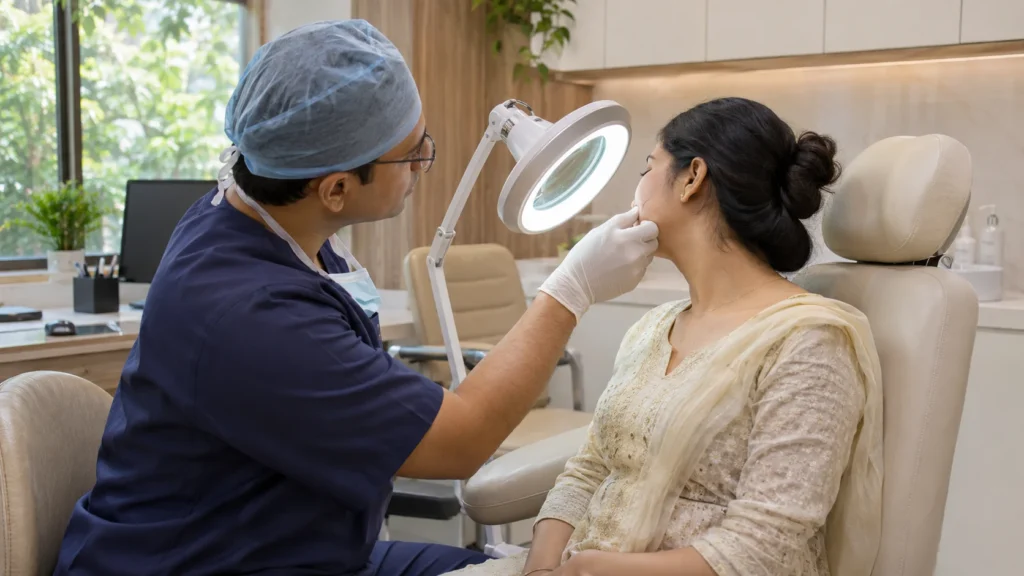
No treatment removes a scar completely – but the right one can turn a noticeable scar into one that people do not see. For scars from injuries and previous surgery, that usually means a surgical revision: the scar is re-cut, re-shaped or re-directed so it lies in the natural lines of your face, often followed by laser to smooth the surface. It is done under local anaesthetic, stitches come out in about a week, and in Ahmedabad it costs roughly for a small scar. If your scar is less than a year old, the most useful advice is often to wait many scars improve a great deal on their own.
If you are looking for facial scar removal, it is worth knowing one thing first: once skin has healed with a scar, there is always a scar. What can change – sometimes dramatically is how much anyone notices it. That is not a small promise. A thick, stretched scar running across the cheek can become a fine pale line that follows a natural crease. A sunken scar that catches the light can be lifted level with the skin around it. A scar pulling the corner of an eyelid can be released. Most of that is surgical work, and it depends less on equipment than on understanding how facial skin moves – which way a scar should run, how to close it without tension, and when to leave it alone. This page explains all three, and what it costs here.
Can a scar actually be removed?
Not in the sense most people hope. Every treatment that exists – surgery, laser, injections, dermabrasion – still leaves a scar. The aim of revision is a better one: thinner, flatter, closer to your skin colour, and lying where the eye does not follow it. We would rather tell you that now than at the consultation. People who expect “much harder to see” are almost always pleased. People who expect “gone” are disappointed by exactly the same result.
Which scars this page is about
- Scars from injuries – cuts, falls, road accidents, sports, dog bites.
- Scars from previous surgery or stitches that healed badly.
- Scars that have stretched, widened, sunk or thickened.
- Scars that pull on an eyelid, nostril or the corner of the mouth.
If your scars are from acne, our acne scar treatment page covers them in detail – subcision, punch techniques and laser. If what you have is dark marks rather than raised or sunken scars, that is pigmentation, and chemical peels are usually the right starting point. Keloids – scars that grow beyond the original wound – are treated differently again and we will discuss them at consultation. |
Why your scar is noticeable
Usually one of four reasons, and knowing which one decides the treatment.
What you see | The cause | What helps |
It runs across the lines of your face | Direction | Z-plasty or W-plasty to re-orient or break it up |
It is wide, stretched or stepped | Tension or a rushed repair | Excision and careful layered closure |
It is sunken and catches the light | Tethering or lost tissue underneath | Subcision or fat grafting |
It is raised, thick or red | Overactive healing | Steroid injections, silicone, sometimes laser |
It is paler than your skin | Lost pigment | Medical micropigmentation to match the colour |
How facial scars are revised
Surgical revision
The old scar is cut out and the skin brought together in layers – deeper stitches take the tension, fine stitches close the surface. The new scar is a fresh start, made carefully, and it is usually finer and flatter than the one it replaced.
the same closure used in mole removal, applied to a scar.
Z-plasty and W-plasty
Your face has natural lines – expression creases and folds. A scar lying along one hides in it; a scar running across them is noticed. Two scars of the same length can look completely different because of direction alone.
- Z-plasty swaps two small triangles of skin. It lengthens a tight scar and turns part of it into a better direction – useful for scars that pull near the eyelid, lip or neck.
- W-plasty re-cuts a straight scar as a fine zig-zag, so the eye cannot follow a single line – useful on the forehead, cheek and chin.
This is what a laser cannot do. It can smooth the surface of a scar; it cannot move it.
For sunken scars
A scar that is pulled down is often held by fibrous bands underneath. Subcision releases those bands with a needle so the skin can rise. Where tissue has actually been lost, a small amount of your own fat can be placed underneath to lift it – which also tends to improve the quality of the skin above.
For raised and thick scars
Steroid injections flatten and soften thick scars over a few sessions. Silicone gel or sheets help too, and are something you can do yourself. Surgery on a thick scar is done cautiously and usually with steroid treatment around it.
For pale scars
A scar that has lost its colour rarely gets it back, and on brown skin a pale line can be more visible than a raised one. Medical micropigmentation places matched pigment into the scar to blend it – the same precision skill used in scalp micropigmentation.
And afterwards
The best results usually combine steps. Surgery fixes the shape and direction; laser resurfacing or dermabrasion six to eight weeks later blends the surface. We plan it as a sequence rather than a single procedure.
When to have it done - and why we often say wait
A scar takes twelve to eighteen months to mature. At two or three months it usually looks its worst – red, raised and firm – and a large proportion of scars improve substantially on their own over the following year. |
Revising a scar before it has matured means operating on tissue that is still changing. So if your scar is less than a year old, we will often suggest waiting – and give you the things that help in the meantime:
- Silicone gel or sheets, daily, once the wound has closed.
- Sun protection on the scar, every day – young scars darken easily in the sun, and on Indian skin that darkening lasts.
- Gentle massage once it is fully healed.
- An early review if it starts to thicken, so it can be treated before it sets.
When earlier is right
- The scar is pulling an eyelid, nostril or the corner of the mouth out of place.
- The original repair was clearly misaligned – a step at the lip border, for example.
- The scar is thickening and needs treatment now.
Areas of the face we treat
Area | What matters there |
Forehead | Horizontal lines make placement easier; vertical scars often need breaking up |
Eyebrow | Hair direction and avoiding a gap in the brow |
Eyelid | Very thin skin; a tight scar can pull the lid – function comes first |
Nose | Thick skin at the tip, thin skin on the bridge – they heal differently |
Cheek | The most common site after injury; direction matters most here |
Lip | The border between lip and skin must line up exactly – a millimetre shows |
Chin and jawline | Scars can often be moved to sit under the jaw line |
Is it different for Indian skin?
Brown skin heals well, and it has two tendencies that change the plan. It is more prone to thick scars and keloids, and it is more likely to darken or lighten after any injury – including treatment.
Tell us if you have ever had a scar grow beyond the original wound – an earlobe after piercing is the most common example. It changes how we approach any surgery, and cutting out a keloid without the right precautions can make it return larger. |
We use conservative laser settings, treat thickening early, and put a lot of weight on sun protection. Pale scars are handled with pigment rather than more surgery.
If you have just cut your face
The best time to improve a facial scar is before it forms. A facial cut closed carefully – edges matched, stitches in layers, fine sutures removed early – heals very differently from the same cut closed quickly. Much of the revision we do corrects repairs that were done in a hurry.
A plastic surgeon can be asked to close a facial wound, and it is worth asking – particularly for cuts on the lip, eyelid or nose, and for children.
Go to an emergency department first if there is heavy bleeding, an eye injury, a head injury, or any loss of consciousness. |
What happens on the day
Step 1 – Assessment
Your scar is examined for its direction, width, depth, colour and age. Photographs are taken in standard lighting. You are told what is realistically possible, whether now is the right time, and which combination of treatments suits it.
Step 2 – Local anaesthetic
A small injection numbs the area. Most facial scar revisions are done under local anaesthetic and you go home the same day.
Step 3 – The revision
Depending on the plan: the scar is excised and closed in layers, re-shaped with a Z- or W-plasty, released with subcision, or filled with fat. Thirty minutes to an hour for most facial scars.
Step 4 – Home
A light dressing, instructions, and a date for stitch removal.
Recovery and aftercare
When | What to expect |
Days 1-3 | Mild swelling and bruising. Keep the dressing dry. |
Days 5-7 | Facial stitches usually come out. Most people are back at work. |
Weeks 2-6 | The new scar is pink. Start silicone gel and sun protection. |
Weeks 6-8 | Laser or dermabrasion, if planned, to blend the surface. |
Months 3-12 | Softening and fading. The scar is still maturing. |
- Avoid stretching the area and heavy exercise for about two weeks.
- No picking at scabs.
- Sun protection every day for a year – this matters as much as the surgery.
- Make-up once the stitches are out and the wound has closed.
Results timeline
A revised scar is a new scar, and it goes through the same year of maturing. At six weeks it will look pink and more obvious than you hoped. At six months it will look considerably better. At twelve months you see the result. Judging it at week six is the most common mistake. |
Facial scar revision cost in Ahmedabad
There is no standard scar, so there is no standard price. Cost depends mainly on the size of the scar, the technique it needs, and whether more than one step is planned.
Treatment | Cost in Ahmedabad |
Consultation | Contact Our Clinic |
Small scar – excision and layered closure | Contact Our Clinic |
Z-plasty or W-plasty | Contact Our Clinic |
Subcision, per session | Contact Our Clinic |
Fat grafting for a sunken scar | Contact Our Clinic |
Steroid injection, per session | Contact Our Clinic |
Laser resurfacing, per session | Contact Our Clinic |
Medical micropigmentation | Contact Our Clinic |
A typical combined plan | Contact Our Clinic |
Scar revision after an accident may sometimes be covered by insurance where it is reconstructive; purely cosmetic revision usually is not.
Surgery, laser or injections - which fixes what?
| Surgery | Laser | Injections |
Changes direction | Yes | No | No |
Narrows a wide scar | Yes | No | No |
Smooths the surface | Partly | Yes | No |
Flattens a thick scar | Sometimes | Partly | Yes |
Lifts a sunken scar | Yes – subcision or fat | Partly | No |
Downtime | About a week | Days to a week | Minimal |
Most good results use two of the three.
Risks and what can go wrong
- The new scar is still a scar, and results vary from person to person.
- Thickening of the revised scar, more likely in keloid-prone skin.
- Darker or paler marks after laser or dermabrasion, particularly in brown skin.
- Infection or wound opening – uncommon on the face, which has a good blood supply.
- Sometimes a second, smaller revision is needed.
Your doctor: Dr Arth Shah, MS, MCh (Plastic Surgery)
Skin treatments at Rejuva Aesthetica are overseen by Dr Arth Shah, who completed his MBBS at Gujarat University in 2009, his MS in General Surgery at Sardar Patel University, Vallabh Vidyanagar in 2014, and his MCh in Plastic and Reconstructive Surgery at B.J. Medical College, Ahmedabad in 2017. He is registered with the Gujarat Medical Council under registration number G-25994 and has practised in Ahmedabad since 2018.
Book a skin consultation in Ahmedabad
A skin consultation takes about twenty minutes. Come without makeup. Your skin type and concern are assessed, the right peel and depth are chosen, and you are told how many sessions you are likely to need and what the whole course costs. If your skin needs preparing first, that starts before the peel does.
Rejuva Aesthetica – Plastic & Cosmetic Surgery Clinic 102, Himalaya Emerald, Besides IOC Petrol Pump, Near Shivranjani Over Bridge, Jodhpur, Ahmedabad, Gujarat 380015 Phone: +91 74360 00990 | 079 2692 9299 Monday to Saturday, 9:00 AM to 7:00 PM. Closed Sundays and public holidays. |
Frequently Asked Question
No treatment removes a scar completely. Revision replaces a noticeable scar with a better one - thinner, flatter, closer to your skin colour and lying in the natural lines of the face. The result is often that people stop noticing it, which is the realistic aim.
It depends on the size of the scar and the technique it needs. Many scars need more than one step, so ask for the cost of the whole plan rather than a single procedure.
Usually about a year. Scars take twelve to eighteen months to mature and often improve a great deal on their own. The exceptions are scars pulling an eyelid or lip out of place, clearly poor repairs, and scars that are thickening.
A technique that swaps two small triangles of skin. It lengthens a tight scar and turns part of it in a better direction, so it pulls less and follows the natural lines of the face.
They do different jobs. Surgery can change a scar's width and direction; laser smooths its surface. For many facial scars the best result comes from surgery first and laser six to eight weeks later.
The local anaesthetic injection stings briefly; after that you feel pressure but not pain. Discomfort afterwards is mild and usually managed with simple painkillers.
At about twelve months. A revised scar is a new scar and goes through the same maturing. It will look pink and more obvious at six weeks, and much better by six months.
Acne scars are treated with their own set of techniques - subcision, punch methods and laser. Our acne scar page covers them in detail.
Yes. Brown skin is more prone to thick scars and to colour change after treatment, so we use conservative laser settings, treat thickening early and put a lot of weight on sun protection. Tell us if you have ever had a keloid.
Lost pigment rarely returns on its own, and surgery cannot restore it. Medical micropigmentation can place matched pigment into the scar so it blends with the surrounding skin.
Facial stitches usually come out in five to seven days and most people are back at work within a week. Swelling and bruising settle over the first week or two.
Yes. Dog bite scars are often irregular and sometimes sunken, and usually respond well to revision once they have matured.
Yes - these are among the most common scars we see. Many have been closed quickly in an emergency and benefit from careful re-closure once they have matured.
Wait for it to mature, protect it from the sun and use silicone gel. Revision can be considered later; in children we tend to wait longer and keep the plan simple.
Sometimes it is slightly longer - a Z- or W-plasty adds length - but it is finer, flatter and better placed, which is what makes it less noticeable.
It is one of the best-supported things you can do yourself for a healing scar, used daily for several months.
Often, yes - with steroid injections over a few sessions, together with silicone. Surgery is kept for scars that do not respond or that need re-shaping.
A thick scar stays within the original wound and often improves with time. A keloid grows beyond it and tends to come back if simply cut out. They are treated differently.
Sometimes when it is reconstructive - after an accident or to restore function. Purely cosmetic revision usually is not.
A carefully closed facial wound heals into a much better scar than a rushed one. For serious injuries, go to an emergency department first.
Some blood thinners and supplements may need to be paused. This is discussed at consultation - do not stop prescribed medicines without advice.
Yes. Stitch removal is about a week later and can sometimes be arranged locally.
Start Today
Ready to Get Started?
Book a complimentary consultation to discuss your goals and receive a personalised treatment plan.