Chemical Peel Treatment in Ahmedabad
Written and medically reviewed by Dr Arth Shah, MBBS (Gujarat University, 2009), MS General Surgery (Sardar Patel University, 2014), MCh Plastic & Reconstructive Surgery (B.J. Medical College, Ahmedabad, 2017). Gujarat Medical Council registration G-25994.
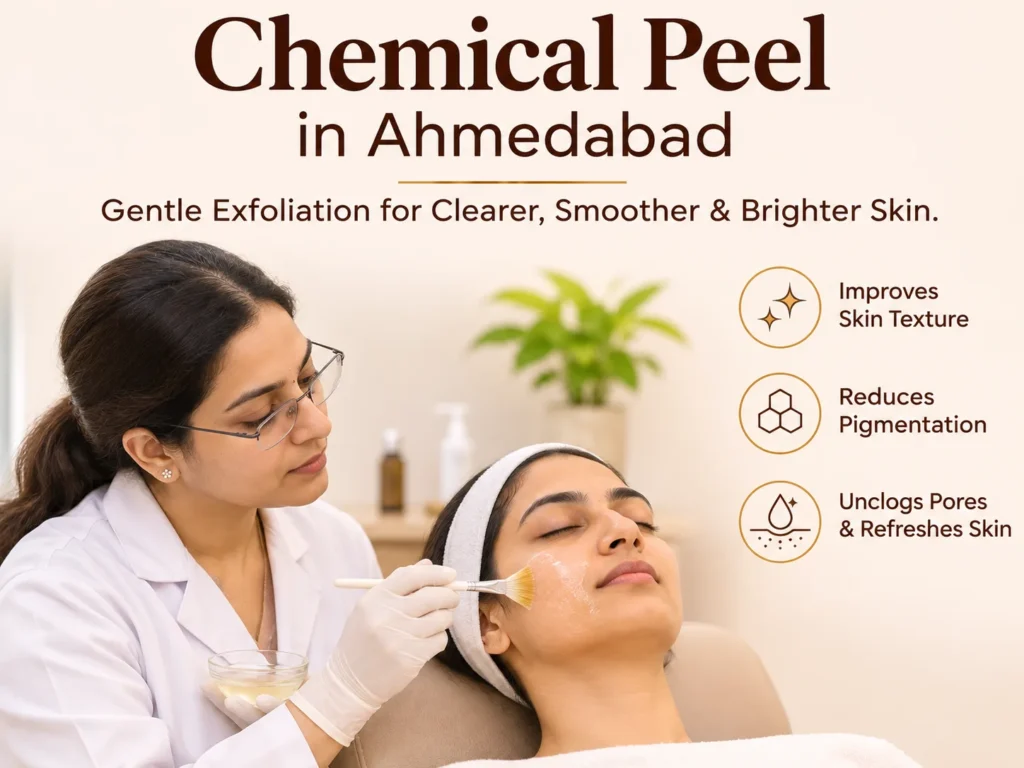
A chemical peel applies an acid to the skin in a controlled way, removing the outer layer so that smoother, more even skin replaces it. Which acid and which strength depends entirely on your skin and your problem – salicylic for acne, glycolic or mandelic for pigmentation, TCA for deeper concerns. In Ahmedabad a session costs roughly Rs 1,500 to Rs 8,500 depending on depth, and most concerns need a course of four to six spaced two to four weeks apart. One thing that governs everything here: in Indian skin, lighter peels done more often work better and more safely than strong ones.
The most common mistake with chemical peels is assuming a stronger one is a better one. It is an understandable assumption and it is the opposite of the truth in skin like ours. Skin with more melanin responds to injury by making more pigment, so an overly aggressive peel can leave darkening that lasts months – and in melasma specifically, it can make the condition worse rather than better. The approach that works here is a lighter peel, repeated, with the skin properly prepared beforehand.
The second most common mistake is treating “a chemical peel” as one thing. There are six or seven acids in regular use and they do different jobs. Salicylic gets into the pore and treats acne. Glycolic works on the surface and brightens. Mandelic penetrates slowly, which makes it one of the safest in darker skin. Choosing wrongly is why people finish a course and see very little. This page covers which peel does what, what the three depths involve, what to expect for pigmentation and melasma specifically, what it costs here, and what can go wrong.
What a chemical peel actually does
An acid solution is applied to the skin for a controlled length of time. It causes a controlled injury to a chosen depth, the treated layer separates and is shed over the following days, and the skin that replaces it is more even in tone and texture. Deeper peels also stimulate collagen as the skin repairs.
The important word is controlled. The depth is chosen by the acid used, its concentration, how long it stays on, and how the skin has been prepared. That is what separates a clinical peel from an over-the-counter product, and it is why the same acid can be a gentle brightening treatment or a significant procedure depending on how it is used.
The three depths
Peels are classified by how deep they go, and the depth determines what they treat, how much downtime there is, and how much risk there is. This is the single most useful thing to understand before choosing one.
Superficial peels
These work on the outer layer of skin only. They treat dullness, uneven texture, mild pigmentation, active acne and blackheads. There is little or no downtime – some mild flaking for two or three days at most, and many people have one and go back to work. They are the workhorse, particularly here. Because each session does a modest amount, they are done as a course – typically four to six sessions two to four weeks apart – and the improvement accumulates.
Medium peels
These go through the outer layer into the upper dermis, and they treat more established pigmentation, fine lines, sun damage and some acne scarring. The trade-off is real downtime: visible peeling for five to seven days and redness for longer. They are used selectively in darker skin, with the skin prepared beforehand and with careful aftercare. Done well they are safe and effective. Done casually they are the commonest cause of post-treatment pigmentation.
Deep peels, and why we do not do them
Deep phenol peels are not appropriate for Indian skin and we do not offer them. They reach the deeper dermis and produce dramatic results in pale, sun-damaged skin. In skin with more melanin they carry a substantial risk of permanent loss of pigment, and a visible demarcation line where treated skin meets untreated skin. In darker skin that line does not fade, and there is no straightforward way to correct it.
If you want the kind of change a deep peel produces, the honest answer is that fractional laser resurfacing achieves comparable results with a far better safety profile in this skin type. That is a different treatment and a different conversation.
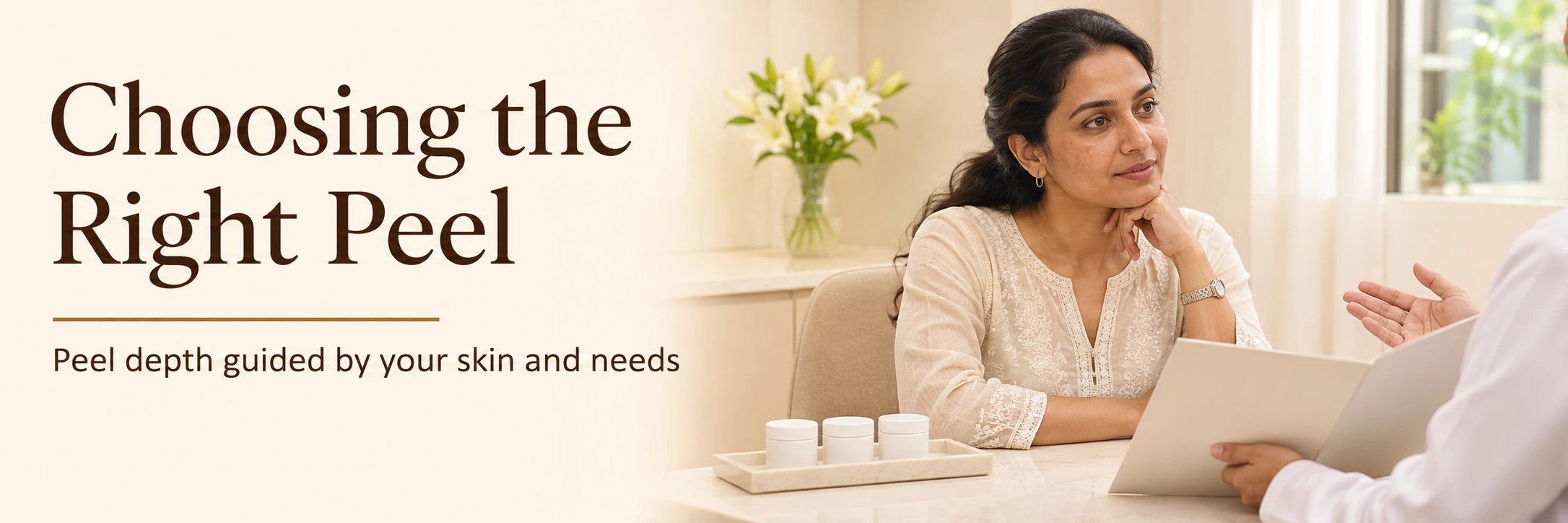
Which peel for which problem
There is no best peel. There is a right peel for your skin and your problem, and choosing wrongly is why people finish a course and see very little.
For acne and oily skin
Salicylic acid. It is oil-soluble, which means it penetrates into the pore itself rather than working only on the surface – and since acne happens inside the follicle, that is exactly where the treatment needs to reach. It is why salicylic beats glycolic for acne even though glycolic is the better-known name. It also reduces oil and has an anti-inflammatory effect. See our acne and acne scar treatment page for how peels fit into a wider acne plan.
For pigmentation and dullness
Glycolic acid is the standard choice – the smallest of the fruit acids, so it penetrates readily and works well on uneven tone, dark marks left by old spots, and general dullness. Lactic acid is gentler and hydrating rather than drying, which suits drier skin. Retinol peels, often sold as yellow peels, are widely used in India for pigmentation and are left on for several hours rather than minutes.
For sensitive or reactive skin
Mandelic acid. Its molecule is considerably larger than glycolic, so it penetrates more slowly and more evenly – which makes it gentler and, importantly, one of the safest options in darker skin because the risk of provoking pigmentation is lower. It is underused, and it is often the right starting point for someone who has never had a peel.
For fine lines and sun damage
TCA, at medium depth. It is the standard agent for going deeper than the surface, and it is adjustable by concentration – the same acid used lightly is a superficial peel and used at higher strength is a medium one. High-concentration TCA is also applied to individual ice pick acne scars in a technique called TCA CROSS, covered on the acne page.
Melasma - what to expect honestly
Melasma is one of the commonest reasons people here seek peels. It is symmetrical brown or greyish patching, usually across the cheeks, upper lip, forehead and jawline, far more common in women, strongly linked to sun exposure and to hormonal change including pregnancy and the contraceptive pill, and considerably more common in skin of colour.
Three things about it deserve saying plainly, because most pages do not.
- It is managed, not cured
Melasma is chronic and relapsing. Treatment lightens it substantially and it can be kept light indefinitely – but stopping treatment and sun protection brings it back. Anyone promising permanent clearance is overstating what is possible, and patients who were promised that are the ones who end up disappointed after considerable expense.
- Aggressive treatment can make it worse
This is the counter-intuitive one and it is the most important. Melasma is driven by inflammation as well as by pigment. A peel that is too strong, or a laser setting that is too aggressive, can provoke the condition rather than clear it – producing more pigment than there was to begin with. In melasma, more aggressive is not better. It is actively worse. That is why the approach here is a series of light peels rather than one strong one, combined with topical treatment, and why a clinic offering you a powerful single-session solution for melasma is offering something that carries real risk of a worse outcome.
- Sun protection is the treatment, not the aftercare
Without daily, year-round, rigorous sun protection no peel course for melasma will hold. In Gujarat that means a habit rather than a summer routine, and it means reapplication rather than one application in the morning. It is the least glamorous part of the plan and it is the part that determines whether the rest of it works.
Preparing your skin first
For most people here, treatment starts two to four weeks before the first peel. Preparing – or priming – the skin with a topical regimen before peeling substantially reduces the risk of pigmentation afterwards, and it makes the peel work better because the skin is more even and more receptive to begin with. In darker skin it is standard practice rather than an optional extra.
It typically means a retinoid, a pigment-suppressing agent, and rigorous sun protection, started before the first session and continued between sessions.
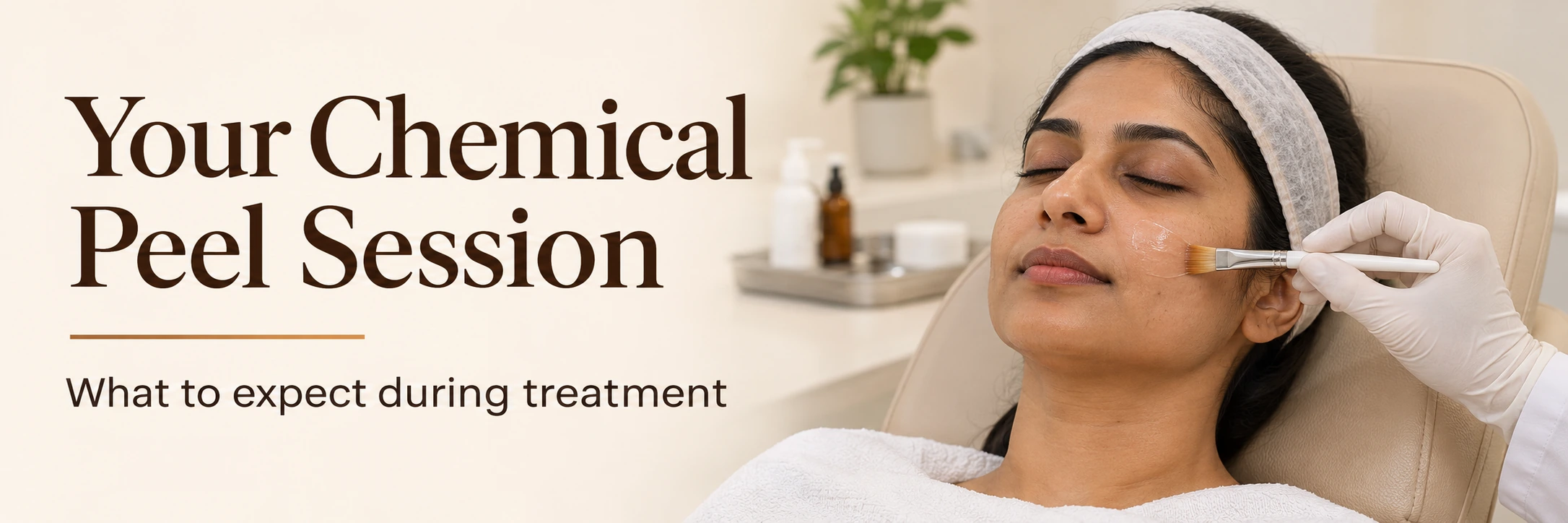
What happens on the day
Twenty to forty minutes depending on the peel. You are awake, it is not painful, and you go straight home afterwards.
Step 1 – Cleansing and preparation
The skin is cleansed thoroughly and degreased, because any residue affects how evenly the acid penetrates. Eyes are protected.
Step 2 – Application
The acid is applied in a specific order – thicker-skinned areas such as the chin, nose and cheeks first, then the thinner skin around the eyes and mouth. That sequence matters, because the acid has been on the first areas longer by the time the last are done, which compensates for the difference in how quickly each penetrates.
You will feel warmth or stinging, usually building over the first minute or two. It is manageable, and a fan is often used for comfort.
Step 3 – Neutralising and removal
The peel is timed and then neutralised or removed, and cool saline compresses are applied to settle the skin and clear any residue.
Step 4 – Going home
A bland moisturiser and sun protection are applied before you leave. You are given written aftercare and told what to expect over the next few days, which differs substantially by depth.
Results timeline
When | What is happening |
Immediately after | Skin looks pink. No result yet – this is the treatment, not the outcome. |
Days 3-7 | Flaking or peeling, depending on depth. Skin looks worse before it looks better. |
Week 2 | Brighter, smoother, more even. This is the first genuine glimpse. |
After 3-4 sessions | Cumulative improvement becomes clear – tone, texture and pigmentation. |
End of a course | The result. Photograph here, in the same lighting as the baseline. |
Maintenance | Held with periodic peels, topical treatment and sun protection. Without those it drifts back. |
Chemical peel cost in Ahmedabad
A superficial peel in Ahmedabad runs roughly Rs 1,500 to Rs 4,000 per session, and a medium peel roughly Rs 4,000 to Rs 10,000. Most concerns need a course of four to six superficial peels, so the figure that matters is the course rather than the session. Chemical peels are cosmetic and are not covered by health insurance.
Peel | Typical cost per session |
Salicylic (acne) | Contact Our Clinic |
Glycolic (pigmentation, brightening) | Contact Our Clinic |
Mandelic (sensitive skin) | Contact Our Clinic |
Lactic (dry or sensitive skin) | Contact Our Clinic |
Retinol / yellow peel | Contact Our Clinic |
Jessner’s | Contact Our Clinic |
TCA (medium depth) | Contact Our Clinic |
A course of six superficial peels | Contact Our Clinic |
Consultation | Contact Our Clinic |
Priming products | Contact Our Clinic |
Peels, lasers or microneedling?
| Chemical peel | Fractional laser | Microneedling |
Works by | Chemical exfoliation to a chosen depth | Controlled thermal injury in columns | Physical injury, sometimes with radiofrequency |
Best for | Pigmentation, tone, texture, active acne | Texture, scarring, deeper resurfacing | Texture and scarring, with less surface injury |
Downtime | None to a week, by depth | Several days to a week | One to three days |
Cost per session | Lowest | Highest | Middle |
In darker skin | Superficial peels are among the safest options | Needs conservative settings and care | Often the safest resurfacing option |
Sessions | 4-6 for a course | 3-6 | 4-6 |
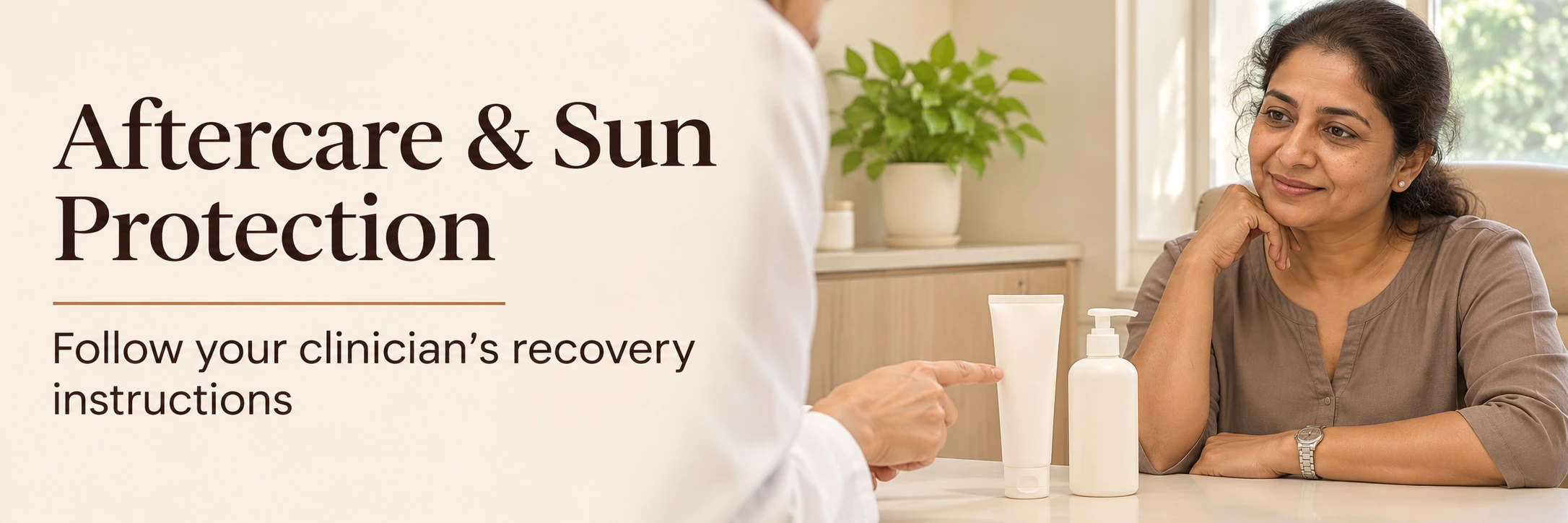
Risks and what can go wrong
Superficial peels are among the safest treatments in aesthetic medicine. The risks rise with depth, and in this skin type they are almost entirely pigmentary rather than structural.
Common and expected
- Redness, tightness and mild stinging during and shortly after.
- Flaking or peeling, by depth.
- Temporary sensitivity to sunlight.
- A brief acne flare after some peels, which settles.
Uncommon
Post-inflammatory hyperpigmentation is the main one, and it is why everything on this page argues for a lighter approach. Darkening after the peel, usually temporary but capable of lasting months. More likely with deeper peels, sun exposure afterwards, inadequate priming, or peeling again too soon.
- Prolonged redness.
- Loss of pigment, rare with superficial and medium peels, and a genuine risk with deep peels – which is why they are not offered here.
- Infection, Cold sores can be reactivated – mention it if you get them.
- Scarring, rare, and associated with deeper peels, picking at healing skin, or infection.
- Worsening of melasma after an overly aggressive peel.
Who should not have a peel
- Anyone with active infection in the area – including an active cold sore.
- Anyone who has recently taken isotretinoin.
- Anyone pregnant or breastfeeding, for certain agents.
- Anyone with a history of keloid scarring, for medium peels particularly.
- Anyone with significant recent sun exposure or a tan – treating recently sun-exposed skin substantially raises the pigmentation risk.
- Anyone unwilling to use sun protection afterwards. Stated plainly, because it is the single behavioural factor that decides the outcome.
- Anyone using active topicals – retinoids, acids – without stopping them beforehand as instructed.
Your doctor: Dr Arth Shah, MS, MCh (Plastic Surgery)
Skin treatments at Rejuva Aesthetica are overseen by Dr Arth Shah, who completed his MBBS at Gujarat University in 2009, his MS in General Surgery at Sardar Patel University, Vallabh Vidyanagar in 2014, and his MCh in Plastic and Reconstructive Surgery at B.J. Medical College, Ahmedabad in 2017. He is registered with the Gujarat Medical Council under registration number G-25994 and has practised in Ahmedabad since 2018.
Book a skin consultation in Ahmedabad
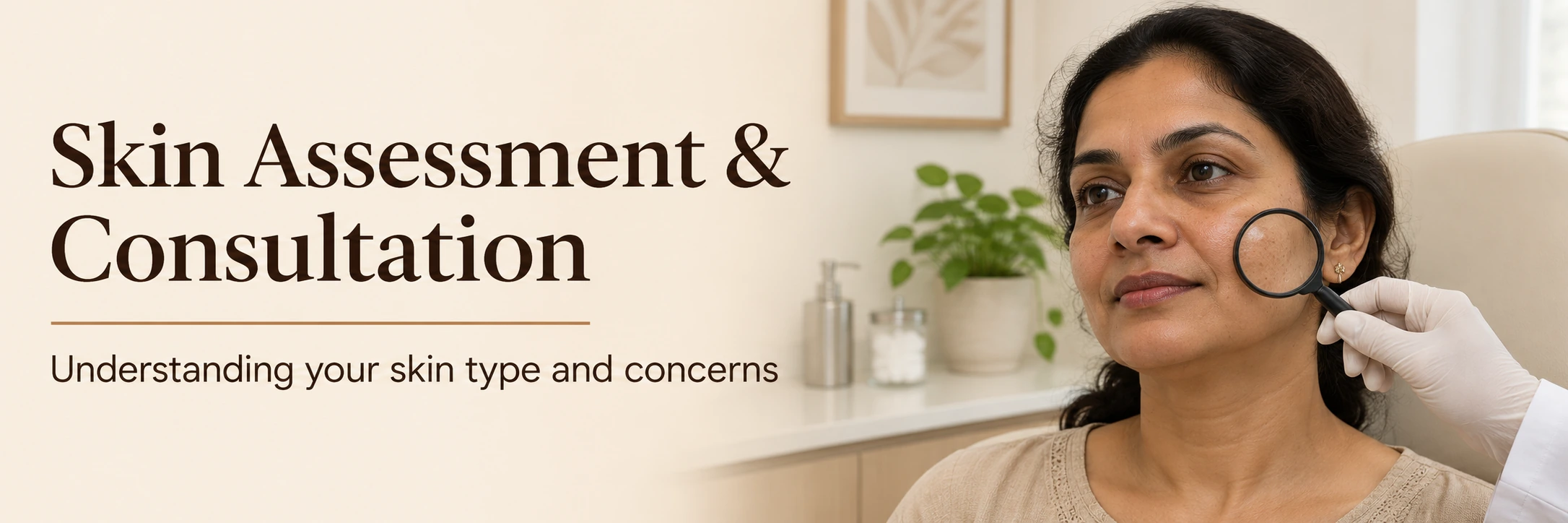
A skin consultation takes about twenty minutes. Come without makeup. Your skin type and concern are assessed, the right peel and depth are chosen, and you are told how many sessions you are likely to need and what the whole course costs. If your skin needs preparing first, that starts before the peel does.
Rejuva Aesthetica – Plastic & Cosmetic Surgery Clinic 102, Himalaya Emerald, Besides IOC Petrol Pump, Near Shivranjani Over Bridge, Jodhpur, Ahmedabad, Gujarat 380015 Phone: +91 74360 00990 | 079 2692 9299 Monday to Saturday, 9:00 AM to 7:00 PM. Closed Sundays and public holidays. |
Frequently Asked Question
A superficial peel runs roughly Rs 1,500 to Rs 4,000 per session and a medium peel roughly Rs 4,000 to Rs 10,000. Most concerns need a course of four to six superficial peels, so ask for the course price rather than the session price. Peels are cosmetic and are not covered by health insurance.
There is no best peel - there is a right peel for your skin and your problem. Salicylic for acne and oily skin, because it is oil-soluble and gets into the pore. Glycolic for pigmentation and dullness. Mandelic for sensitive or darker skin, because it penetrates slowly. Lactic for dry skin. TCA for deeper concerns. Choosing wrongly is the commonest reason a course of peels disappoints.
Superficial peels are among the safest treatments available for this skin type. The consideration is that skin with more melanin can respond to injury by producing more pigment, so the approach that works is lighter peels done more often, with the skin prepared beforehand and protected from the sun afterwards. Deep phenol peels are a different matter and we do not offer them.
Usually four to six superficial peels, spaced two to four weeks apart, followed by maintenance every few months. Medium peels are done less often - one to three, spaced further apart. The spacing matters: peeling again before the skin has recovered raises the risk without improving the result.
It depends entirely on the depth. A superficial peel often produces no visible peeling at all, or fine flaking for two or three days. A medium peel produces conspicuous peeling in sheets over five to seven days that cannot be covered with makeup. Plan a medium peel around your calendar rather than the other way round.
It helps, and it is worth being clear about what that means. Melasma is chronic and relapsing - treatment lightens it substantially and keeps it light, but stopping treatment and sun protection brings it back. Importantly, aggressive treatment can make melasma worse rather than better, because the condition is driven by inflammation as well as pigment. A series of light peels with topical treatment alongside is the approach that works.
In darker skin, usually yes - two to four weeks of a topical regimen before the first peel. It substantially reduces the risk of pigmentation afterwards and makes the peel work better because the skin is more even to begin with. It is standard practice and it is worth asking any clinic whether they do it.
Salicylic peels help with active acne, blackheads and oily skin, because salicylic acid is oil-soluble and reaches into the pore. They work best alongside proper medical acne treatment rather than instead of it - see our acne page for how peels fit into a wider plan.
Peels improve surface texture and the marks left behind by acne, which is often what people mean. True atrophic scarring - visible dents and pits - needs different treatment, usually subcision, TCA CROSS or laser. A clinic offering peels as scar treatment is offering something that will not do what you want.
Not really. You feel warmth or stinging that builds over the first minute or two and settles. A fan is often used for comfort. It is short, and no anaesthetic is needed for superficial or medium peels.
A retinol-based peel, applied and left on for several hours rather than minutes, then washed off at home. It is widely used in India for pigmentation and melasma and is heavily marketed. It produces peeling over the following days. Like any peel, whether it suits you depends on your skin and your concern.
After a superficial peel, usually the next day. After a medium peel, once peeling is complete. Applying makeup over actively peeling skin makes the peeling look worse and risks irritation.
Some agents are avoided in pregnancy and breastfeeding, others are considered acceptable. It needs discussing rather than assuming either way.
It needs raising at consultation. Guidance on the interval after isotretinoin has changed in recent years and is now debated rather than settled.
Recently sun-exposed or tanned skin should not be peeled - the pigmentation risk rises substantially. It is worth planning treatment away from holidays and outdoor events rather than immediately after one.
No. It comes away when it is ready. Pulling it early removes skin that was not ready to go and is the commonest cause of a mark afterwards - which is the opposite of what you came for.
A brightness change after the first session, usually visible at around two weeks once any flaking has finished. Real cumulative improvement in tone and texture appears after three or four sessions. Peels are a course rather than a single event.
They do different jobs. Peels are better for pigmentation, tone and active acne, cost less per session and carry less downtime. Laser is better for texture and scarring. In darker skin, superficial peels and radiofrequency microneedling are often safer starting points than ablative laser. Frequently the answer is a combination.
Yes - back, chest, hands and underarms are all treated. Body skin responds more slowly than facial skin and usually needs more sessions.
The improvement from a course lasts, but skin continues to age and pigment continues to be produced - particularly with sun exposure. Results are maintained with periodic peels, topical treatment and sun protection rather than being permanent on their own.
Usually yes - active ingredients such as retinoids and acids are stopped for a few days before a peel to reduce the risk of over-exfoliation. You will be given specific instructions
Yes, and a good number do - for acne, texture and pigmentation. The treatment is identical. Shaving is usually avoided for a day or two either side.
Start Today
Ready to Get Started?
Book a complimentary consultation to discuss your goals and receive a personalised treatment plan.